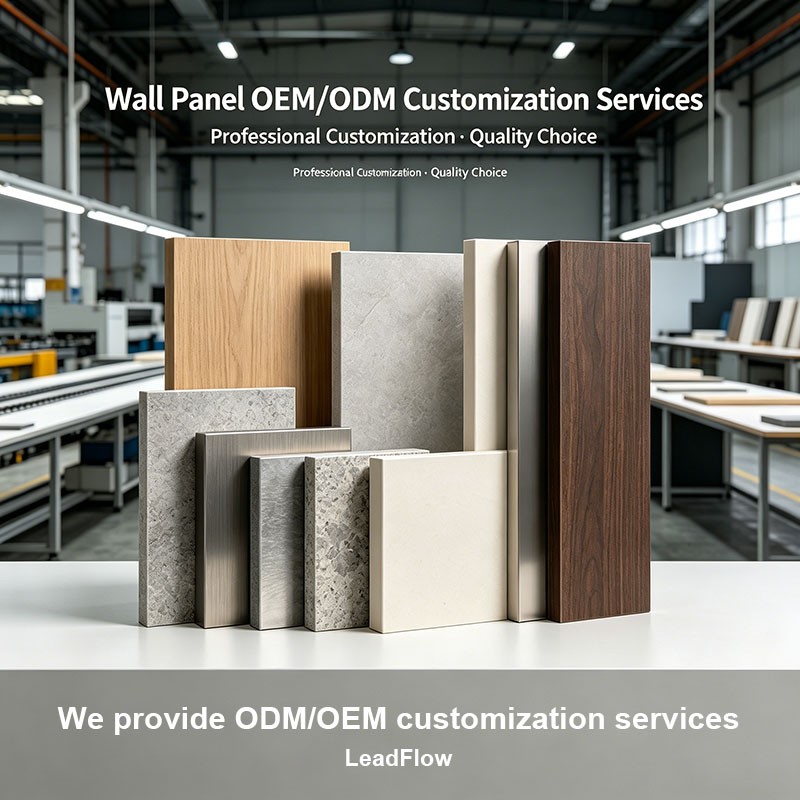
If you are a contractor, developer, or distributor sourcing wall panels for overseas projects, you have likely encountered the alphabet soup of modern cladding materials: WPC, SPC, WET, and more. At LeadFlow, we manufacture these solutions daily, and we know that choosing the wrong material can kill your margins and your reputation.
This guide cuts through the marketing fluff. We will break down exactly what WPC wall panels are, where they excel, where they fall short, and how they stack up against SPC and WET panels—so you can match the right product to the right job site.
What Exactly Is a WPC Wall Panel?
WPC stands for Wood-Plastic Composite. Think of it as the "hybrid SUV" of the wall panel world.
The Recipe: 40–60% plant fiber (wood flour, bamboo, or rice husks) + 30–50% thermoplastic resin (PVC for interiors, PE for exteriors) + coupling agents and stabilizers.
The Process: The mixture is extruded under high heat (180–220°C) and pressure, then cooled and textured to mimic natural wood grain or stone.
The Vibe: It looks like wood, feels warmer than plastic, but acts like a synthetic—meaning no painting, no rotting, and no termites.
The "Pros" List: Why Specifiers Love WPC
1. The "Forgiving" Install
Unlike rigid SPC, WPC has slight flexibility. If your substrate has minor unevenness (within 2mm), WPC adapts without cracking. You can saw, nail, and screw it using standard woodworking tools—no diamond blades or specialty drills required.
2. Thermal & Acoustic Comfort
The wood content lowers thermal conductivity, meaning it feels warmer to the touch than stone or SPC. In hollow-core versions, it also delivers 2–3dB better sound insulation than solid SPC—a huge selling point for hotel corridors and home theaters.
3. Aesthetic Authenticity
Because wood fibers are part of the matrix, the embossed-in-register textures don't look like cheap stickers. The grain has micro-variation, which helps high-end residential and boutique commercial projects pass the "touch test."
4. Cost-Effective for Large Surfaces
For broad living room feature walls, office lobbies, or retail display areas, WPC hits a price-to-performance sweet spot—more upscale than PVC foam, but less expensive than solid hardwood or stone veneer.
The "Cons" List: Where WPC Needs Careful Handling
1. The Water Line (Literally)
WPC has an absorption rate of 0.5–1.5%. That is great for humidity and splashes, but it is not waterproof. In continuous submerged conditions or steam rooms, the wood fibers can swell, leading to edge blistering. For showers, steam rooms, or exterior rainy facades—do not use standard PVC-WPC.
2. UV Fading
Without an ASA co-extrusion or premium UV topcoat, WPC will oxidize and fade under intense direct sunlight (especially tropical climates). Indoor use? Perfect. Outdoor use? Only if you specifically order PE-WPC with UV stabilizers and a co-extruded cap layer.
3. Thermal Movement
With a linear expansion coefficient of 0.8–1.2 mm/m·°C, WPC expands and contracts more than wood. If you or your client’s installers skip the expansion gaps (6–8m intervals) or fasten it rigidly, you will get buckling callbacks within the first summer.
The Ultimate Showdown: WPC vs. SPC vs. WET (LeadFlow's Factory Comparison)
At LeadFlow, we manufacture all three, so we have no bias toward one—only toward the right fit. Here is the blunt, factory-floor truth:
| Feature | WPC (Wood-Plastic) | SPC (Stone-Plastic) | WET (Waterproof Engineered Technology) |
|---|---|---|---|
| Core Makeup | Wood fiber + PVC/PE (30–50% plastic) | 60–70% Calcium Carbonate (stone) + PVC | Fully closed-cell PVC + mineral fillers (0% wood) |
| Density | 0.9–1.2 g/cm³ (Light) | 1.5–2.1 g/cm³ (Heavy) | 1.3–1.6 g/cm³ (Mid-weight) |
| Water Resistance | Good (splashes, humidity) | Excellent (<0.1% absorption - submersible) | Excellent (zero organic content - submersible) |
| Impact Resistance | Moderate (absorbs shock, no chipping) | High (hard surface, can chip under heavy point impact) | High (tough but lighter than SPC) |
| Flexibility | Can cold-bend for slight arcs (R >300mm) | Rigid—breaks before bending | Moderate—good for flat or mild curve |
| Screw Holding | Excellent (3x wood) | Poor (pre-drill required; prone to stripping) | Good (pre-drill recommended) |
| Ideal Zone | Dry indoor walls, bedrooms, offices, feature ceilings | Bathrooms, kitchens, basements, hospitals, wet areas | High-end spas, luxury wet rooms, marine-grade interiors |
| Core Risk | Swelling if fully submerged; UV fade outdoors | Heavy; hard to cut; cold feel | Higher cost; requires specific adhesives |
Decision Matrix for B2B Buyers
Choose WPC (LeadFlow's WPC series) when:
- The project is a residential villa, apartment complex, or hotel bedroom.
- You need wood-like warmth and acoustic dampening.
- The installation site is dry-to-normal humidity.
- Your crew uses standard carpentry tools and wants fast cutting/trimming.
Choose SPC (LeadFlow's SPC Stone Crystal series) when:
- The site is a basement, coastal hotel, laundry room, or shower enclosure.
- The local climate has 90%+ humidity for months.
- The building code requires zero-percent water absorption.
Choose WET (LeadFlow's WET panels) when:
- The project budget allows for premium "install-and-forget" performance.
- You are cladding commercial pools, spas, or exterior facades with severe weather.
- You need a mid-weight solution that bridges the gap between WPC's warmth and SPC's waterproofing—without wood's inherent risks.
Smart Sourcing Advice for Importers (From Our Factory Floor)
Demand the "Cut Test": When you receive samples, snap a piece in half. If the WPC core is grayish or has large black specks—walk away. That is regrind/ recycled waste. Virgin WPC shows a uniform beige or light brown cross-section.
Sniff Before You Spec: A sharp, ammonia-like odor indicates cheap stabilizers. That smell off-gasses VOCs, and your end-user will complain.
Check the Film Adhesion: Take a utility knife and try to peel the decorative film at a 90° angle. If it lifts easily, the lamination line is substandard—it will delaminate within 2 years in shipping containers.
Ask for the Fire Report: For commercial projects, you need B1-s1, d0 (European standard) or ASTM E84 Class A. Do not accept the "fire retardant" verbal claim without the test number.
Final Verdict
There is no "best" wall panel—only the best fit for the environment and the installer. At LeadFlow, we do not push one product; we engineer solutions so you win bids and avoid callbacks.
For your next hotel project: WPC for the bedrooms (quiet, warm, wood-feel), SPC for the bathrooms (hard, wet, zero maintenance), and WET for the spa entryway (premium, bombproof).
We are a factory, not a trading company. That means we control the formulation, the color matching, and the packaging for 40ft containers. If you are spec'ing for a development or bidding on a commercial renovation, contact our export team for samples and a loadability plan tailored to your port.