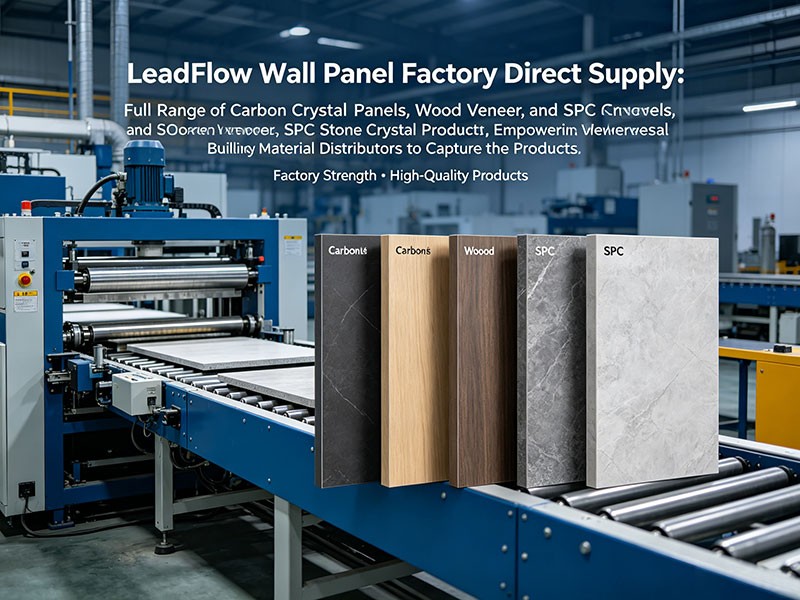
You have seen the showrooms. You have flipped through the glossy brochures. Every supplier claims their wall panels are "revolutionary." But when you are the one signing the purchase order for a 40ft container headed to a job site 8,000 miles away, you need facts—not slogans.
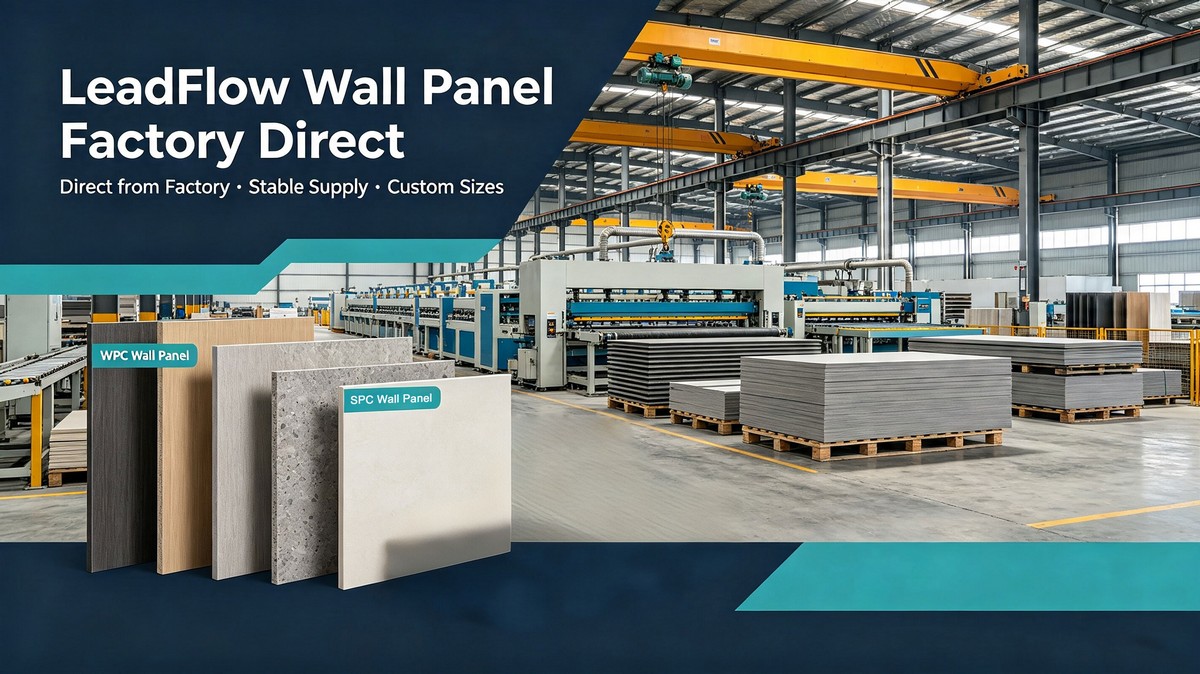
At LeadFlow, we extrude millions of linear meters of WPC, SPC, and WET panels every quarter. We see the returns. We analyze the failures. And we know exactly what works in the field versus what looks good on a sample board.
This is not another generic product introduction. This is a factory-floor breakdown of WPC wall panels—the real economics, the hidden installation traps, and the hard numbers that matter to your bottom line.
Part 1: The Real Cost of WPC (Beyond the Price Per Square Meter)
Most buyers compare price per sheet. That is a rookie mistake. Here is what your P&L actually needs to account for:
Initial Material Cost: WPC sits in the mid-range. Cheaper than solid hardwood or high-end stone veneer. More expensive than basic PVC foam board. Typical wholesale pricing (FOB China) ranges from $8–$18 per square meter depending on thickness (5mm–10mm), surface treatment, and co-extrusion layer.
Logistics Weight: At 0.9–1.2 g/cm³, WPC is significantly lighter than SPC (1.5–2.1 g/cm³). A 40ft HC container loaded with WPC panels holds approximately 1,800–2,200 sheets (depending on thickness) versus 1,200–1,500 sheets of SPC. That is 30–40% more product per shipping dollar—a number that transforms your landed cost.
Installation Labor: WPC cuts with standard carbide-tipped saw blades. No diamond blades. No specialized scoring tools. A two-man crew can install 80–100 sqm per day using basic carpentry skills. Compare that to tile (15–20 sqm/day) or SPC's stricter substrate preparation requirements. Lower labor hours = more competitive bids.
Maintenance (Lifetime Cost): Zero. No painting. No sealing. No anti-termite treatments. Over a 15–25 year service life, WPC saves your end-client an estimated $6–$10 per sqm annually in avoided maintenance versus painted timber.
Part 2: Performance Data That Matters (No Fluff)
We tested our own LeadFlow WPC panels against industry benchmarks. Here are the numbers your technical spec sheets need:
| Parameter | LeadFlow WPC (Virgin Grade) | Industry Average | Testing Standard |
|---|---|---|---|
| Water Absorption (24hr immersion) | 0.6% | 1.2–1.8% | ASTM D570 |
| Flexural Strength (MPa) | 28.5 | 18–22 | ASTM D790 |
| Modulus of Elasticity (GPa) | 4.2 | 3.0–3.5 | ASTM D790 |
| Screw Withdrawal Force (N) | 1,850 | 1,200–1,500 | ASTM D1761 |
| Surface Hardness (Shore D) | 68 | 58–62 | ASTM D2240 |
| Linear Thermal Expansion (mm/m·°C) | 0.85 | 0.9–1.1 | Internal Method |
| Flame Spread Index | 95 (Class B) | Varies widely | ASTM E84 |
Parameter LeadFlow WPC (Virgin Grade) Industry Average Testing Standard
Water Absorption (24hr immersion) 0.6% 1.2–1.8% ASTM D570
Flexural Strength (MPa) 28.5 18–22 ASTM D790
Modulus of Elasticity (GPa) 4.2 3.0–3.5 ASTM D790
Screw Withdrawal Force (N) 1,850 1,200–1,500 ASTM D1761
Surface Hardness (Shore D) 68 58–62 ASTM D2240
Linear Thermal Expansion (mm/m·°C) 0.85 0.9–1.1 Internal Method
Flame Spread Index 95 (Class B) Varies widely ASTM E84
The takeaway: Our formulation uses a higher resin-to-wood ratio and a proprietary coupling agent (maleic anhydride grafted polyolefin). This means better moisture encapsulation and significantly higher screw-holding power—critical when panels are installed on ceilings or external facades where gravity works against you.
Part 3: The Five Hidden Installation Traps (And How LeadFlow Engineers Around Them)
Trap #1: The Rigid Fastening Mistake
WPC moves. If your installer uses standard drywall screws without rubber washers or self-tapping flange heads, the panel will stress-crack around the fastener within 18 months.
Our Fix: LeadFlow panels include pre-marked nailing zones. We supply matching stainless-steel screws with integrated EPDM washers that allow 1.5mm of horizontal float. The screw bites, but the panel slides.
Trap #2: The "Zero-Gap" Assumption
We have seen installers butt WPC panels tight "for a seamless look." Then summer arrives, the panel expands, and you get a tented wall.
Our Fix: We laser-etch expansion markers on every panel's reverse side. For interior applications, leave 1mm per linear meter. For exterior or sun-exposed walls, 1.5mm per meter. And never install without a 10mm buffer at the top and bottom tracks.
Trap #3: Substrate Moisture Ignorance
WPC is moisture-resistant, not a vapor barrier. If you install it over a green concrete wall (moisture content >5%), trapped moisture will condense on the backside and promote mold growth on the wood fibers—even if the face looks perfect.
Our Fix: We require all LeadFlow distributors to include a moisture meter check in their pre-installation checklist. Moisture content >4%? Install a 0.2mm PE vapor barrier first. It costs pennies and eliminates 90% of post-installation complaints.
Trap #4: Wrong Adhesive for Glue-Up Applications
Not all construction adhesives are compatible. Solvent-based adhesives can actually dissolve the plastic matrix of WPC, leading to delamination.
Our Fix: We publish a certified adhesive compatibility list (polyurethane and MS-polymer hybrids recommended). Share it with your contractor. No guessing.
Trap #5: Edge Sealing Neglect
Cut edges expose raw wood fibers. In humid environments, these exposed edges absorb moisture faster than the factory-sealed faces, causing localized swelling.
Our Fix: We offer an optional edge-sealing wax stick with every bulk order. Ten seconds of rubbing on each cut edge adds 5–8 years of edge integrity in tropical climates. That is a competitive advantage your competitors will not mention.
Part 4: WPC vs. WET vs. SPC—The "When to Say No" Guide
Because we manufacture all three, we can afford to tell you when not to use WPC. And we do—because a happy client is a repeat client.
| Scenario | Recommended Product | Why Not WPC? |
|---|---|---|
| Hotel shower walls | SPC or WET | WPC's 0.6% absorption eventually allows micro-swelling behind tile trim; SPC is 0.05%—effectively zero. |
| Outdoor garden facades (direct rain) | WET or PE-WPC | Standard PVC-WPC lacks UV stability; PE-WPC with ASA cap is acceptable, but WET is bombproof. |
| School corridor (high student traffic) | LeadFlow Impact-Guard WPC | Our proprietary impact-grade WPC has a steel-reinforced backer layer. Standard WPC can dent from hard backpacks. |
| Luxury residential (budget unlimited) | WET | WET has zero wood content, zero swelling risk, and a ceramic-like finish—worth the premium for high-end specs. |
| Office partition walls | Standard LeadFlow WPC | Ideal. Lightweight, good acoustics, easy to reconfigure. |
| Freezer rooms / cold storage | SPC | WPC becomes brittle below -5°C; SPC maintains impact resistance down to -20°C. |
Scenario Recommended Product Why Not WPC?
Hotel shower walls SPC or WET WPC's 0.6% absorption eventually allows micro-swelling behind tile trim; SPC is 0.05%—effectively zero.
Outdoor garden facades (direct rain) WET or PE-WPC Standard PVC-WPC lacks UV stability; PE-WPC with ASA cap is acceptable, but WET is bombproof.
School corridor (high student traffic) LeadFlow Impact-Guard WPC Our proprietary impact-grade WPC has a steel-reinforced backer layer. Standard WPC can dent from hard backpacks.
Luxury residential (budget unlimited) WET WET has zero wood content, zero swelling risk, and a ceramic-like finish—worth the premium for high-end specs.
Office partition walls Standard LeadFlow WPC Ideal. Lightweight, good acoustics, easy to reconfigure.
Freezer rooms / cold storage SPC WPC becomes brittle below -5°C; SPC maintains impact resistance down to -20°C.
Part 5: Why LeadFlow? The Factory Difference
You are not buying from a trading desk. You are buying directly from the extrusion line. Here is what that means for you:
Formula Control: We use 100% virgin PVC resin and fine-mesh wood flour (120 mesh). No recycled industrial waste. Our cross-section is uniformly beige—not grey, not speckled.
Color Matching: Our in-house color lab matches any RAL or Pantone code within 48 hours. For bulk orders, we lock the color batch so every container matches the previous one.
Packaging for Transit: Each panel is interleaved with 0.15mm PE foam to prevent scratching. Containers are blocked and braced with inflatable dunnage bags—our damage rate at destination is under 0.3% (industry average: 2–4%).
MOQ Flexibility: New distributor? Start with a mixed container (WPC + SPC + accessories). No 500-sheet minimum per SKU. We want you to test the market, not drown in inventory.
The LeadFlow Promise
We know that your reputation rides on every container you ship. That is why every LeadFlow panel carries a batch number traceable to the exact extrusion shift, raw material lot, and quality inspector.
We do not hide our defects—we correct them. And we share those lessons with our partners so you can avoid the same pitfalls.
Ready to Spec Smarter?
Send our export team a drawing of your next project. We will respond with a product recommendation, a load plan, and a per-sqm landed cost estimate to your nearest port. No obligation. Just factory-level honesty.
Because the best wall panel is the one that stays on the wall—and your client stays happy.