The rapid ascent of the carbon crystal wall panel is quietly redrawing the competitive map of the interior wall cladding industry. Harder than conventional wood-plastic boards, flatter than painted drywall and far faster to install than natural stone, this next-generation panel has become a fixture in residential renovations, hotels and commercial fit-outs across Asia, Europe, the Middle East and the Americas. Yet the true story of this product is not written in showrooms — it is written on the production floor. Understanding how a carbon crystal wall panel factory formulates, forms, coats and inspects its panels has become essential due diligence for any distributor, contractor or design professional sourcing decorative panels at scale.
Key Takeaways
• A carbon crystal wall panel is typically built on a PVC and calcium carbonate core enriched with finely dispersed carbon-based additives, then finished with PET film lamination or UV-cured coatings.
• Factory capability — formulation control, extrusion precision, lamination adhesion and in-line inspection — determines panel performance far more than catalog imagery.
• Many leading production bases operate multiple product lines, serving simultaneously as a WPC Wall Panels supplier and a carbon crystal producer under one roof.
• Buyers should audit formulation transparency, third-party test reports, OEM/ODM flexibility and export packaging standards before committing to volume orders.
What Is a Carbon Crystal Wall Panel? A Factory-Level Definition
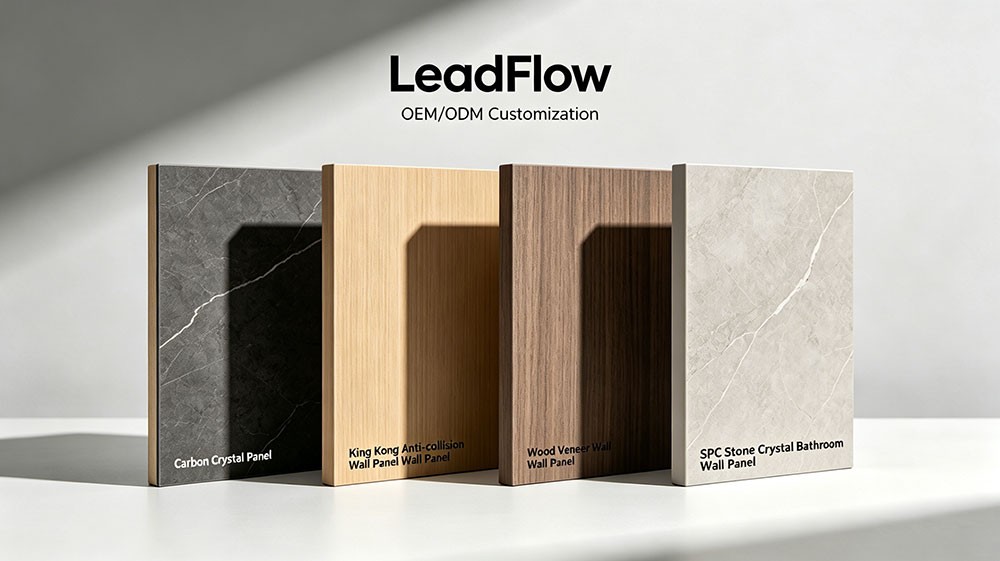
A carbon crystal wall panel is a rigid decorative cladding board produced by compounding PVC resin with a high proportion of calcium carbonate and finely milled carbon-based additives, forming the blend into flat sheets, and bonding the surface with PET decorative film or UV-cured coatings. The name refers less to a single chemical substance than to a formulation philosophy: by dispersing carbon-family powders through the polymer matrix, manufacturers aim to raise surface hardness, density and dimensional stability beyond what standard wood-plastic compositions deliver.
The contrast with traditional WPC is instructive. Wood-plastic composites rely on wood fiber suspended in plastic, which gives panels a warmer, wood-like feel but can leave them more prone to surface softness and subtle warping. Carbon crystal panels push inorganic filler content higher, and the cause-and-effect is well understood in polymer processing: more mineral content means greater rigidity, better flatness and improved behavior under heat, but it also demands tighter process discipline. Mixing temperature, screw speed and calendering pressure must be calibrated precisely, or the finished sheet risks brittleness, surface defects and weak film adhesion. This is precisely why factory-level engineering capacity — not trading capability — defines quality in this category.
Formats are equally pragmatic. Panels are commonly produced in thicknesses of roughly three to nine millimeters, in widths suited to standard container shipping, and in surface styles spanning marble veining, fabric texture, brushed metal and solid matte finishes. The same forming lines can also profile grooved and fluted surfaces, which is why fluted design options increasingly sit beside flat carbon crystal sheets in the same manufacturer portfolio.
Inside the Production Line: From Raw Material Blending to UV Coating
Manufacturing carbon crystal wall panels follows a tightly sequenced industrial workflow in which formulation, forming, finishing and inspection feed directly into one another.
The process begins with raw material dosing and mixing. PVC resin, calcium carbonate, stabilizers, processing aids and carbon-based additives are weighed — increasingly by automated dosing systems — then blended in high-speed hot mixers before being cooled to prevent clumping and preserve additive dispersion. Consistency at this stage echoes through the entire product: an uneven mix surfaces later as color drift, density variation or brittle edges.
Next comes extrusion and sheet forming. The compound is fed through extruders into a calendering or mold system that sets the panel thickness, density and core structure. Skilled operators monitor melt temperature and line speed continuously, because even a fraction-of-a-millimeter deviation in thickness becomes visible as shadow lines once panels are installed side by side.
Surface finishing is where the product earns its market appeal. PET decorative film — prized for scratch resistance and vivid, consistent printing — is thermally bonded to the board, or the surface is routed through UV primer and topcoat lines that cure instantly under ultraviolet lamps. The finishing choice shapes everything from gloss level to wear performance, and it is one of the clearest differentiators between small workshops and serious factories.
Downstream, panels move to profiling, cutting and inspection. Grooving equipment mills V-joints, tongue-and-groove edges or fluted channels; saws cut panels to length; and quality teams check density, thickness tolerance, film adhesion and batch-to-batch color consistency before protective film and export-grade packaging are applied. The same infrastructure — extrusion know-how, lamination capacity, grooving tooling — supports adjacent categories, which is why many plants pair carbon crystal output with SPC Wall Panel wholesale programs and other rigid board lines to keep equipment running at efficient utilization across seasonal demand cycles.
Choosing a Carbon Crystal Wall Panel Factory: Sourcing Benchmarks for Global Buyers
For importers, wholesalers and project contractors, the deciding factor is rarely the sample on the desk — it is the system standing behind the sample. Several benchmarks separate dependable manufacturers from opportunistic traders.
Formulation transparency and safety documentation. Serious factories can describe their base resin and filler ratios in general terms, state which stabilizer systems they use, and provide independent third-party test reports covering formaldehyde and volatile organic compound emissions as well as flame classification. Reluctance to discuss composition or testing is a warning sign in itself.
Verifiable process control. Ask what is actually measured on the line: thickness gauges, adhesion cross-hatch tests, impact sampling and batch traceability records indicate a quality culture rather than a marketing claim. A factory confident in its process will usually welcome audits or video inspections.
Portfolio depth and supply resilience. Multi-line manufacturers offer a structural advantage. A plant that operates as a WPC Wall Panels supplier, produces rigid stone-polymer boards and serves as a WPC Fluted Wall Panels supplier for grooved decorative profiles allows buyers to consolidate orders into fewer containers, lower freight cost per square meter and hedge against demand shifting between product categories. In volatile trade cycles, that breadth is risk management as much as convenience.
Customization and export competence. OEM and ODM capability — custom colors, slot widths, panel dimensions and branded packaging — matters for distributors building private-label lines, while experienced export teams bring moisture-proof packaging, optimized container loading and accurate documentation. For project buyers, the ability of a carbon crystal wall panel factory to supply matched trims, adhesives and installation guidance often decides whether a program scales smoothly or stalls on site.
Conclusion and Market Outlook
The carbon crystal wall panel is completing its transition from trend product to mainstream interior category, and that shift is reshaping the factories behind it. Manufacturers that invest in formulation science, automated dosing, precision lamination and transparent quality reporting are pulling away from trading-led competitors, while multi-line plants that span WPC, SPC and carbon crystal production are consolidating their position as one-stop sourcing bases for global buyers. Looking ahead, expect three currents to accelerate: deeper automation on forming and finishing lines, stronger sustainability expectations around recyclable offcuts and low-emission coatings, and rising demand from renovation-driven markets in Europe, North America, the Middle East and Southeast Asia. For buyers, the practical conclusion is simple — evaluate the factory as a system, not the panel as an object, and the quality of every container that follows will reflect that diligence.
FAQ
Q: What is a carbon crystal wall panel made of?
A: A carbon crystal wall panel is typically made from a compounded core of PVC resin, calcium carbonate filler and finely dispersed carbon-based additives, combined with stabilizers and processing aids, then finished by PET film lamination or UV-cured coatings that create a hard, decorative surface.
Q: How does a carbon crystal wall panel differ from a WPC wall panel?
A: WPC wall panels use wood fiber within the polymer matrix, giving a warmer, wood-like character, while carbon crystal panels carry higher inorganic content for greater hardness, flatness and a stone-like surface finish. Both are moisture-resistant; the right choice depends on the desired aesthetic, application area and budget.
Q: Can carbon crystal wall panels be installed in bathrooms and kitchens?
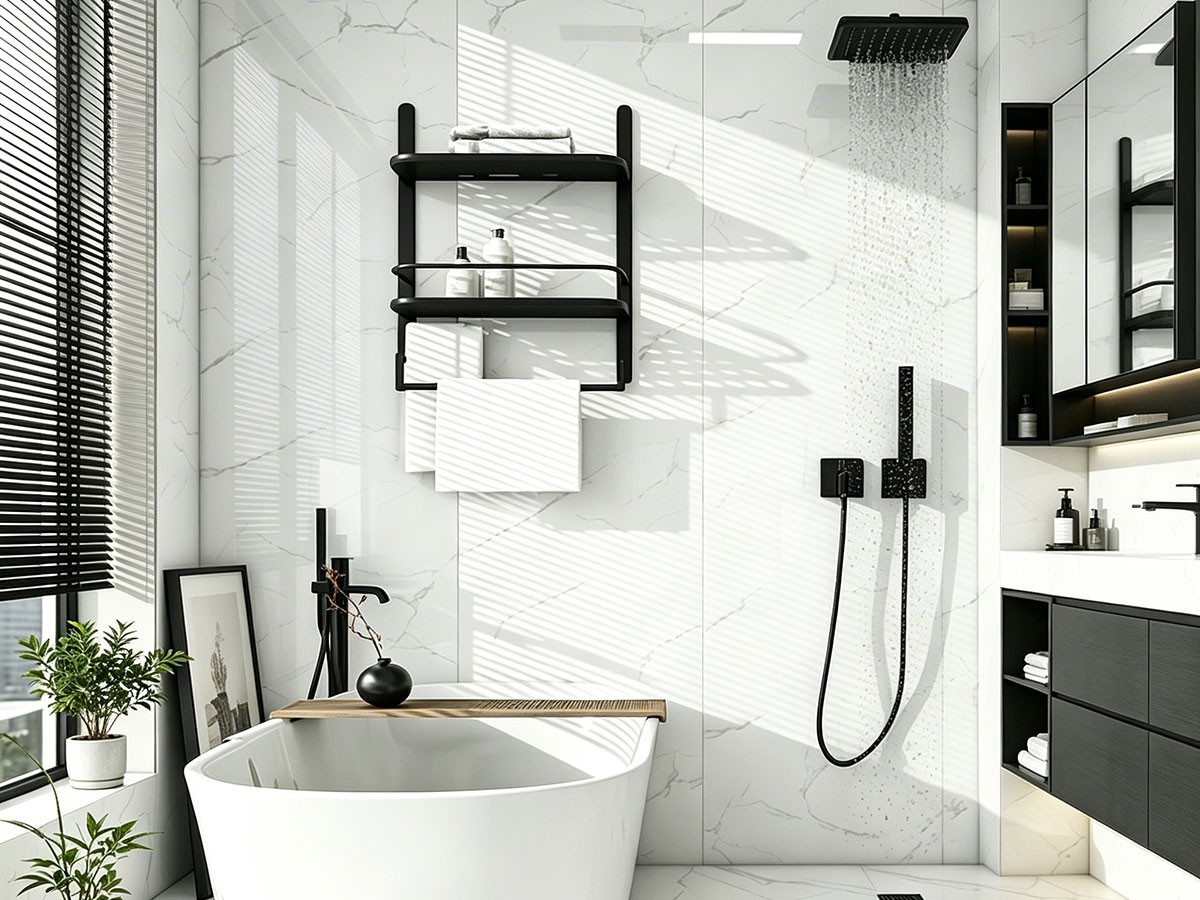
A: Yes. The dense, water-resistant core makes the panel suitable for humid interior environments, and it is widely used for bathroom and kitchen feature walls. In areas with direct water exposure, installers should still seal joints and use matching trims to keep moisture out of the wall cavity.
Q: What should I verify before placing a bulk order with a panel factory?
A: Request independent test reports for emissions and flame performance, compare bulk production samples against initial samples, confirm film adhesion and thickness tolerance standards, review OEM/ODM and packaging options, and check whether the supplier can also cover related categories such as WPC and SPC panels for consolidated shipping.