
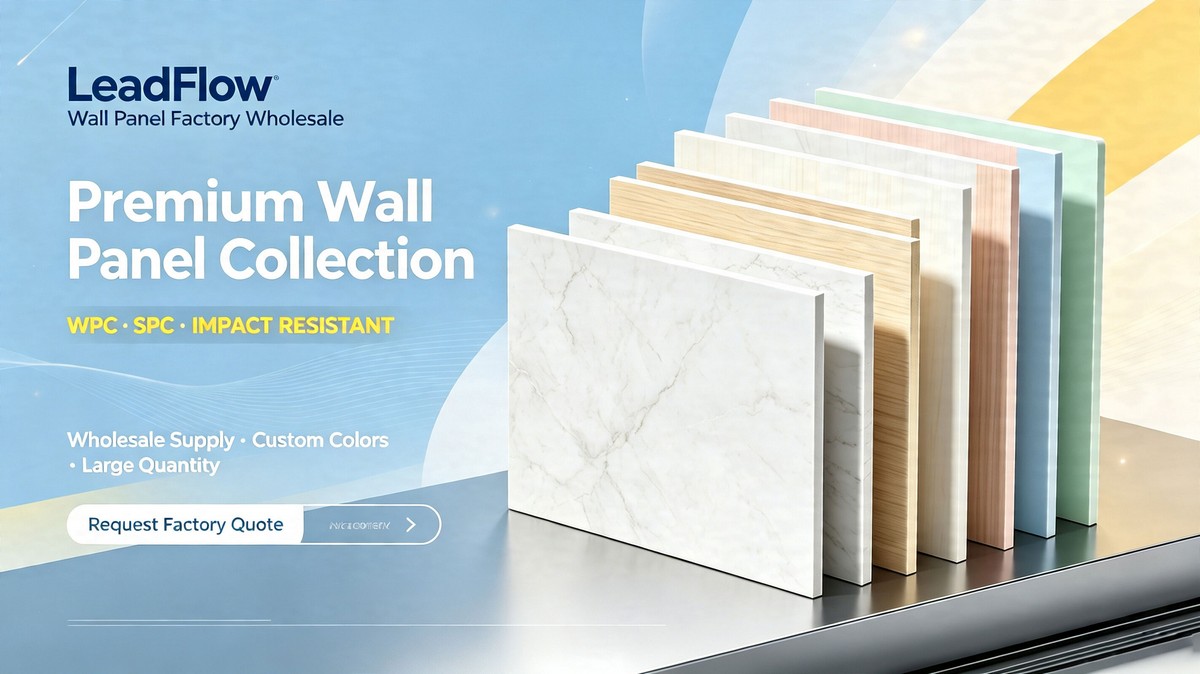
The rapid rise of WPC wall panels in residential and commercial interiors—feature walls in living rooms, full-height cladding in hotels, offices, and retail spaces—owes as much to manufacturing innovation as to design appeal. Behind the wood-grain textures, crisp fluted geometries, and matte or high-gloss finishes that specifiers now expect lies a production process that has shifted decisively from semi-manual crafting to fully automated, precision-controlled manufacturing. Understanding how premium WPC wall panels travel from raw materials to finished goods is essential for distributors, contractors, and project buyers who need to separate genuinely engineered products from inconsistently made alternatives.
Key Takeaways
• Premium WPC wall panel quality is determined at the formulation stage, where wood fiber, polymer resin, and additives are combined in automated, gravimetrically controlled batches.
• Twin-screw extrusion and co-extrusion technology produce dense, dimensionally stable panels with a protective, UV-resistant surface layer in a single continuous pass.
• Inline laser gauges and vision inspection systems detect dimensional and surface defects in real time, delivering batch-to-batch consistency that manual production cannot achieve.
• End-to-end batch traceability and automated packaging give wholesale buyers and project contractors verifiable confidence in every shipment.
Raw Material Formulation: Where WPC Wall Panel Quality Is Decided
The quality of a premium WPC wall panel is determined long before the material reaches the extruder. A standard wood-plastic composite formulation blends wood flour or wood fiber—typically accounting for roughly half to two-thirds of the mix by weight—with polymer resin (most commonly PVC for interior wall panels), calcium carbonate filler, and a precise package of functional additives, including UV stabilizers, foaming regulators, lubricants, and color pigments. Each ingredient plays a defined role: the wood fiber delivers natural texture and rigidity, the polymer matrix provides moisture resistance and workability, and the additives govern long-term color stability and impact performance.
Automation enters at the very first step. Modern plants feed wood flour through drying systems that reduce moisture to tightly controlled levels, because excess moisture is a leading cause of voids, blistering, and surface waviness in the finished panel. Resin, filler, and additives are then metered by gravimetric dosing systems—loss-in-weight feeders and automated scales that verify each batch to within grams—before high-speed heating-cooling mixers blend everything into a uniform dry compound. This eliminates the manual weighing and hand-mixing that once made quality unpredictable. For a WPC Fluted Wall Panels supplier, owning this formulation capability is a genuine commercial differentiator: it allows the supplier to tune density, flexural strength, and surface hardness for specific applications, from humidity-prone bathrooms to high-traffic commercial lobbies, while keeping ratios identical across every production run.
Extrusion and Co-Extrusion: The Heart of the WPC Wall Panel Production Process
Extrusion is the core of the WPC wall panel production process, and it is where automation delivers its most visible gains. The dry blend is conveyed into twin-screw extruders, which heat, pressurize, and homogenize the compound across multiple independently controlled temperature zones. Programmable logic controllers hold barrel temperatures, screw speed, and melt pressure within narrow windows, so the compound exits the die in a consistently plasticized state—something periodic manual adjustment can never guarantee across long production shifts.
As the profile leaves the die, it enters a vacuum calibration table where water-cooled calibrators set the panel's exact geometry. For fluted designs this stage is especially critical: the grooves and ridges that create the three-dimensional fluted effect must hold sharp edges and uniform spacing along the full panel length. Downstream, automated haul-off units draw the profile at a matched speed while inline laser gauges continuously measure thickness and width, feeding data back to the control system for instant correction.
Many premium lines also employ co-extrusion, bonding a thin, UV-stabilized polymer cap layer onto the panel core during the same pass. This outer skin markedly improves color fastness, stain resistance, and cleanability—key reasons co-extruded panels dominate specification-grade projects. Surface decoration follows the same automation logic in adjacent product categories: in factories running multiple decorative lines, a UV Marble Sheet manufacturer applies UV-cured lacquer that hardens within seconds, producing marble-like gloss and surface hardness on PVC-based boards. That coating know-how increasingly transfers to WPC wall panels, where UV topcoats add scratch and stain resistance to fluted and flat profiles alike. Buyers weighing material options will find that many of the practical differences between WPC and PVC wall panels trace back to precisely these extrusion and coating decisions.
Quality Assurance, Traceability and Smart Packaging: From Line to Finished Goods
Finished-goods quality in a modern WPC wall panel factory rests on layered inspection and end-to-end traceability, both of which are now largely automated. On the line, vision inspection cameras scan for surface defects such as pinholes, streaks, and color variation, while laser systems verify dimensional tolerances; panels that deviate are rejected automatically before they reach the cutting stage. Offline laboratory testing complements inline control, with samples routinely checked for density, impact resistance, moisture absorption, and fire performance, and many premium formulations engineered to meet recognized flame-retardancy classifications for interior building materials.
Automated cut-to-length saws then size each panel to order, while stacking, film-wrapping, and carton-packing systems prepare goods for shipment with minimal manual handling—reducing edge damage, one of the most common causes of customer complaints. Increasingly, manufacturing execution systems link every finished carton to its raw-material lots and process parameters, creating batch-level traceability that allows any issue to be isolated to a specific production window. This matters commercially: for distributors sourcing SPC Wall Panel wholesale volumes alongside WPC assortments, consistent A-grade output and verifiable traceability are decisive selection criteria, because a single inconsistent shipment can stall an entire project installation. Installers benefit as well—anyone who has followed an installation guide for fluted wall panels knows that factory-level dimensional consistency directly determines joint alignment and installation speed on site.
Conclusion and Outlook: Automation as the New Benchmark for Wall Panel Sourcing
The journey from wood flour and resin pellets to a finished, protected, and traceable WPC wall panel now runs almost entirely through automated systems—gravimetric dosing, closed-loop extrusion, inline optical inspection, and robotic packaging. The effect has been to convert wall panels from a variable, craft-style product into an engineered building material with measurable, repeatable properties. Looking ahead, three developments will deepen this shift: AI-assisted vision inspection capable of catching subtler surface defects, digital twins that simulate extrusion parameters before physical trials, and higher recycled-content formulations enabled by cleaner automated sorting. For global buyers, the practical takeaway is straightforward: when evaluating a WPC wall panel partner, ask specifically about formulation control, co-extrusion capability, inline inspection, and batch traceability. These four indicators reveal more about long-term product performance than any catalog image—and they are exactly where automation separates premium manufacturers from the rest.
FAQ
Q: What raw materials are used to make WPC wall panels?
A: Premium WPC wall panels typically combine wood flour or wood fiber with polymer resin (usually PVC for interior panels), calcium carbonate filler, and functional additives such as UV stabilizers, foaming regulators, lubricants, and pigments. The ratio is engineered to balance strength, moisture resistance, density, and surface finish quality.
Q: How does automated production improve WPC wall panel quality?
A: Automation keeps formulation ratios consistent through gravimetric dosing, stabilizes extrusion temperature and pressure through closed-loop control, and detects dimensional or surface defects in real time with inline laser and vision systems. The combined result is tighter tolerances, lower defect rates, and batch-to-batch consistency that manual production cannot match.
Q: What is co-extrusion and why does it matter for WPC wall panels?
A: Co-extrusion bonds a thin, UV-stabilized protective cap layer onto the panel core during the same extrusion pass. This outer layer improves color fastness, stain resistance, and cleanability, significantly extending the panel's service life and appearance retention in interior applications.
Q: How can buyers verify a manufacturer's production capability?
A: Buyers should ask about extrusion line capacity and automation level, whether co-extrusion and inline inspection are used, what batch traceability systems exist, and whether third-party reports cover density, flame retardancy, and emissions. A factory tour or live video audit of the production line offers further confirmation.
Have a custom requirement? Contact our engineering team for tailored renderings and professional advice on premium WPC wall panel production.








