
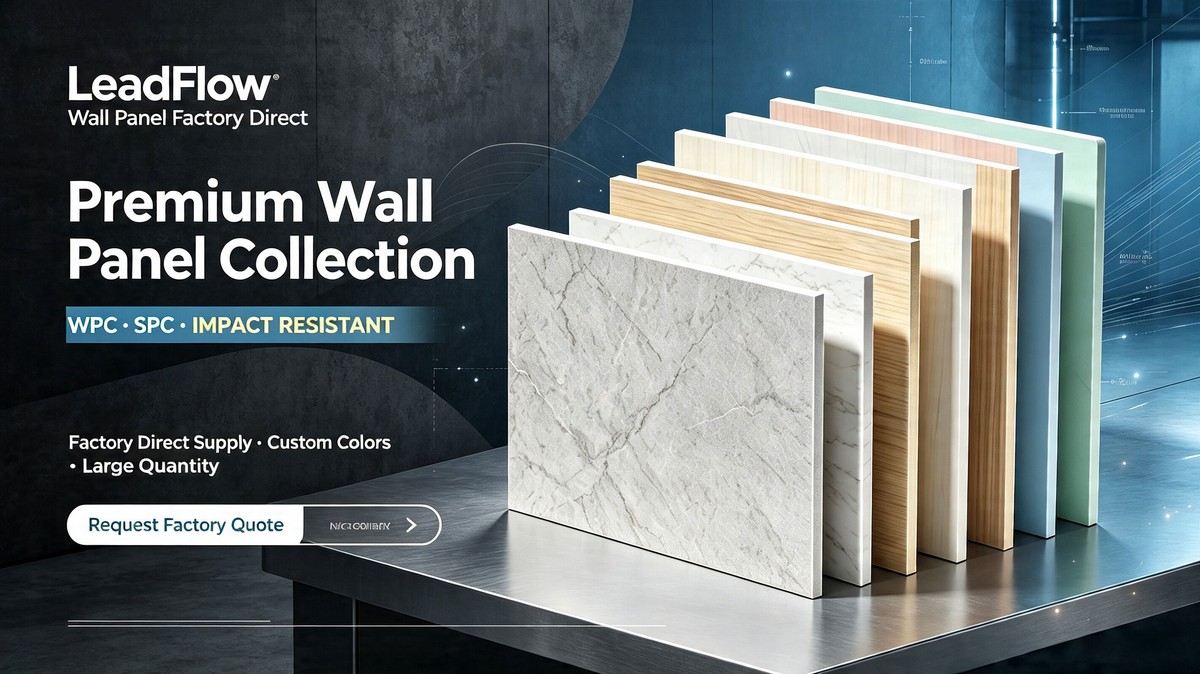
Every wall panel purchase ultimately comes down to a question hidden inside the board: what is the core actually made of? As decorative wall cladding replaces paint, tile, and wallpaper in residential and commercial projects across the globe, buyers are increasingly choosing between two competing core technologies — wood-plastic composite and stone-plastic composite. The distinction is far from academic. The core determines weight, moisture behavior, rigidity, installation method, and the long-term appearance of a finished wall. This WPC vs SPC wall panel deep dive dissects both material systems, compares their real-world performance, and outlines what buyers should verify before committing to a supplier.
Key Takeaways
• A WPC wall panel uses a wood-plastic composite core — wood flour or plant fiber blended with thermoplastic resin — producing lighter panels with a warm, timber-like character that suits fluted and decorative interiors.
• An SPC wall panel uses a stone-plastic composite core — PVC resin fused with a high proportion of calcium carbonate — delivering a denser, more rigid board with excellent dimensional stability in humid environments.
• Neither core is universally superior: WPC favors design flexibility and lower shipping weight, while SPC favors rigidity, wet-area performance, and large-format flatness.
• In a supply chain where many factories run multiple product lines, verifying the actual formulation — resin quality, filler loading, density tolerance — matters more than the category name printed on the quotation.
Understanding the Cores: What WPC and SPC Actually Are
Precise definitions are the starting point of any meaningful material comparison, because the two acronyms describe fundamentally different engineering approaches.
A WPC (wood-plastic composite) core combines wood flour or plant fiber — most commonly wood powder or rice husk — with a thermoplastic matrix such as PVC or polyethylene, together with stabilizers and, in many wall panel formulations, foaming agents. The compound is extruded into profiles that may be solid or micro-foamed, then finished with a decorative film, lamination, or co-extruded protective layer. The resulting panel behaves more like refined timber than stone: lighter in the hand, easy to cut and route, and well suited to the deep fluted and slatted profiles that dominate contemporary interior design (see our guide to fluted wall panel styles for profile options).
An SPC (stone-plastic composite) core takes the opposite approach. It is built primarily from PVC resin fused with a heavy loading of calcium carbonate — powdered limestone — plus processing stabilizers. The technology was first engineered for rigid flooring, where dimensional stability under load is critical, and was later adapted into wall panel formats. Because the core contains no organic fiber, an SPC board is dense, hard, and essentially inert when exposed to water.
Between the two sits a family of adjacent products that buyers frequently encounter in the same catalog. Carbon crystal wall panels, for instance, use a rigid, mineral-rich board enhanced with carbon-based additives and finished with high-gloss or skin-feel PET films. When auditing a Carbon Crystal Wall Panel factory, it helps to know that the underlying board technology shares more engineering DNA with SPC-style rigid formulations than with foamed WPC — a distinction that becomes obvious when comparing edge strength and impact resistance across product lines.
WPC vs SPC Wall Panel Performance: Where Each Core Excels
The fairest way to compare the two cores is to test them against the real conditions of an installation. Five factors consistently decide the outcome.
Moisture resistance. Both materials are marketed as waterproof, and relative to MDF, plywood, or gypsum board, both genuinely resist water. The decisive difference is composition: WPC contains organic fiber that can absorb a small amount of moisture over time even when encapsulated in plastic, whereas an SPC core is non-hygroscopic. In bathrooms, laundry rooms, and coastal interiors with sustained humidity, SPC holds a clear advantage in long-term dimensional stability.
Rigidity and format. The density of an SPC core allows wide panels to stay flat without additional framing support, which is why it performs well in large-format and seamless wall applications. WPC panels, particularly foamed profiles, trade some rigidity for weight savings and are easier to mill into intricate fluted geometries. For a feature wall with deep grooves, WPC is usually the more practical substrate; for a flush, tile-like wall surface, SPC is hard to beat.
Weight and logistics. A lighter WPC panel reduces freight cost per unit, simplifies one-person installation, and places less load on partition walls — a real consideration in renovation projects with existing structures. Heavier SPC boards cost more to ship and handle but deliver a substantial, solid feel that many buyers associate with quality.
Thermal and acoustic behavior. The wood content and micro-cellular structure of WPC give it a slightly warmer surface temperature and a softer acoustic response, which contributes to the perception of comfort in bedrooms and hospitality spaces. The greater mass of SPC lends solidity under impact and can modestly improve sound insulation in wall assemblies.
Fire and safety performance. Both cores are thermoplastic, meaning neither panel is fireproof, and both will soften under high heat. WPC's wood fiber adds a modest fuel load, while SPC's mineral filler dilutes combustible content. In either case, specifiers should request recognized fire classification test reports rather than relying on generic fire-retardant claims.
Sourcing Reality: How the Supply Chain Shapes Your Decision
In daily trade, the WPC versus SPC choice is often settled at the sourcing stage rather than the drawing board, because formulation quality varies more between factories than between categories. Understanding how manufacturers structure their product lines helps buyers ask the right questions.
Many export-oriented plants operate several production technologies under one roof — WPC profile extrusion, SPC board production, UV-coated sheet lines, and rigid decorative board lines. Distributors sourcing through SPC Wall Panel wholesale channels should pay particular attention to calcium carbonate loading: filler reduces cost, but excessive loading makes boards brittle and prone to edge chipping during transport. Requesting density specifications, a cross-section sample, and the ratio of virgin to recycled resin will reveal more than any product photo.
A UV Marble Sheet manufacturer occupies a complementary niche rather than a competing one. These factories produce large rigid PVC sheets coated with UV-cured lacquer that replicates marble veining, typically used for TV feature walls, lobby accents, and coordinated wall schemes. Many project buyers now specify UV marble sheets alongside WPC fluted strips and SPC flat panels to build a complete decorative wall system from a coordinated supplier group — an approach explored further in our overview of integrated wall panel systems.
Regardless of category, the same vetting checklist applies: inspect a cut sample for core uniformity and film adhesion, confirm density and thickness tolerances, verify decorative film sourcing, review certifications relevant to the destination market, and clarify packaging standards for long sea freight, where edge protection determines whether panels arrive sellable.
Conclusion: Matching the Core to the Application
There is no universal winner in the WPC versus SPC debate — only the right core for the right wall. WPC rewards projects that prioritize design flexibility, lighter handling, and warm, tactile surfaces; SPC rewards projects that demand rigidity, moisture resilience, and dimensional stability at scale. Buyers who anchor their decisions in the actual formulation, rather than in category labels, consistently achieve better outcomes.
Looking ahead, the boundary between the two technologies will continue to blur. Co-extruded WPC with harder surface layers, SPC panels engineered for thinner large formats, and multi-line factories offering WPC, SPC, UV marble, and carbon crystal products as a single coordinated system are all reshaping procurement. For distributors and contractors, the competitive edge will belong to those who can read a cross-section as confidently as a price list.
FAQ
Q: Which is better for bathrooms, a WPC wall panel or an SPC wall panel?
A: SPC is generally the safer choice for wet zones. Its mineral-filled core contains no wood fiber and does not absorb water, giving it better long-term dimensional stability in constant humidity. WPC panels are also water-resistant and perform well in bathrooms with good ventilation, but their organic fiber content makes them slightly more vulnerable to moisture-related movement over time.
Q: Is a WPC wall panel more expensive than an SPC wall panel?
A: Not necessarily. Pricing depends on density, resin quality, decorative film, and order volume rather than on the category label. A premium WPC panel with a high-end PET film can cost more than a basic SPC board, and vice versa. Comparing formulations and finished samples is the only reliable way to assess value.
Q: Can WPC and SPC wall panels be combined in the same project?
A: Yes, and this is increasingly common. A typical scheme uses WPC fluted or slatted panels for dry feature walls and bedrooms, while SPC panels are specified for bathrooms, kitchens, and high-traffic commercial areas where rigidity and moisture stability matter most. Matching film finishes allow the two cores to coexist visually.
Q: How can I verify core quality before placing a bulk order?
A: Ask the supplier for density and thickness tolerance specifications, the ratio of virgin to recycled resin, and filler loading details. Then cut a physical sample in half: a uniform, tightly bonded cross-section with strong film adhesion indicates good manufacturing, while visible voids, brittle edges, or peeling film are warning signs regardless of the product category.








