The decorative wall cladding market is in the middle of a structural transition. Ceramic tile, wallpaper, and painted gypsum — the long-standing defaults of interior finishing — are steadily losing ground to rigid composite panels that install faster, resist moisture, and ship at predictable costs. At the center of this shift sits SPC Wall Panel wholesale sourcing: the practice of buying stone plastic composite wall panels in bulk directly from manufacturing plants. For distributors, importers, and contractors worldwide, wholesale procurement is no longer a back-office task; it has become a competitive strategy that determines margins, product differentiation, and project timelines. This article examines what is driving demand, how the factory-to-container supply chain actually works, and which criteria separate reliable suppliers from risky ones.
Key Takeaways
• SPC wall panels combine PVC resin with calcium carbonate to create a waterproof, dimensionally stable core — a key reason the material is displacing tile and wallpaper in moisture-prone and high-traffic interiors.
• Wholesale pricing is not a single number: thickness, density, surface treatment, decorative film quality, and order volume each move the quoted price meaningfully.
• Certifications, factory audits, and total landed cost analysis matter more to long-term profitability than headline per-square-meter quotes.
• Diversified factories that produce SPC panels alongside UV marble sheets and carbon crystal panels allow buyers to consolidate assortments in mixed containers and cut freight costs per unit.
Why SPC Wall Panel Wholesale Demand Keeps Climbing Across Global Markets
The growth of SPC Wall Panel wholesale trade is fundamentally a materials-substitution story. Stone plastic composite — a blend of PVC resin, calcium carbonate powder, and stabilizers extruded into a rigid core — solves problems that traditional wall finishes never fully addressed. In bathrooms, hotel corridors, retail fit-outs, and coastal properties, moisture causes wallpaper to peel and paint to blister, while tile demands skilled labor, grout maintenance, and heavy substrates. SPC panels, by contrast, are inherently waterproof, resist impact, and can be fixed directly over existing walls with adhesive or locking edges.
Installation speed is the second driver. Most SPC wall panels use tongue-and-groove or click edges that let a small crew finish large wall areas in a fraction of the time required for tiling, with minimal dust and no wet trades. For renovation projects operating on tight schedules — hotel room refreshes, retail brand rollouts, office retrofits — that labor saving often outweighs the material cost itself. The cause-and-effect chain is straightforward: faster completion means earlier revenue for property owners, which makes specifiers increasingly willing to approve composite cladding.
A third factor is the maturing design language of the category. Early composite panels were criticized for looking plastic. Current production lines, however, pair high-definition decorative films with deep embossing and matte UV coatings, producing marble, fabric, wood, and concrete effects that stand up to close inspection. This aesthetic upgrade has moved SPC wall panels from budget renovations into mid- and upper-market specification. Buyers assembling a wholesale assortment should note a useful division of labor: fluted and linear profiles remain the territory of the WPC fluted wall panel category, while SPC dominates applications where rigidity and water resistance are non-negotiable.
From Factory Floor to Freight Container: How the Wholesale Supply Chain Works
Wholesale buyers who understand the production process negotiate better and specify more accurately. SPC wall panel manufacturing begins with raw material batching: PVC resin, calcium carbonate (commonly more than half of the formulation by weight, which is what gives the panel its rigidity), and stabilizers are mixed, heated, and extruded through a die into a continuous rigid core. The core is then cooled, cut to length — panel lengths around 2.9 meters are common in global trade — and laminated with a printed decorative film before receiving a protective UV coating or wear layer.
Quality control at this stage separates serious exporters from opportunistic ones. Reputable factories monitor core density and thickness tolerance batch by batch, test the adhesion between core and decorative film, check surface flatness under raking light, and maintain color consistency across production runs so that panels ordered months apart still match on site. Buyers should treat a factory's willingness to document these procedures — and to provide third-party test reports — as a primary screening signal.
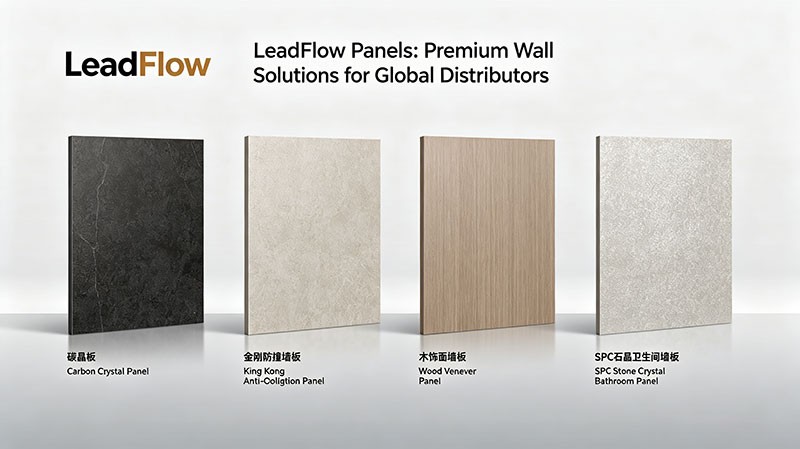
The logistics layer of wholesale sourcing has also matured. Minimum order quantities are typically structured around container loads, and many factories now load mixed designs, thicknesses, and even product categories into a single shipment to help buyers optimize freight. This is where supplier diversification pays off: a Carbon Crystal Wall Panel factory that also operates SPC and WPC extrusion lines can fill one container with rigid SPC panels for full wall coverage, carbon crystal panels for high-end feature walls, and complementary trims — reducing the per-unit freight cost that often erodes wholesale margins. Production lead times of roughly two to four weeks, followed by ocean transit, are the norms buyers should plan project schedules around.
Evaluating Wholesale Suppliers: Price Structure, Certification, and Total Landed Cost
The most common mistake in SPC Wall Panel wholesale purchasing is comparing quotations without normalizing their specifications. A quoted price is a function of at least five variables: panel thickness (with ranges from roughly 4 to 9 millimeters typical across the market), core density, edge system, surface treatment, and decorative film quality. Two quotes that differ by twenty percent may describe visibly different products — or nearly identical ones with different packaging and trade terms. Professional buyers therefore insist on like-for-like specification sheets before comparing numbers.
Compliance documentation is the second pillar of supplier evaluation. Export-oriented factories should be able to provide CE documentation for European markets, fire-performance test reports, and laboratory results for formaldehyde and VOC emissions from recognized institutions. These documents protect the buyer's own market access and are increasingly demanded by general contractors and public-sector projects. A supplier that hesitates to provide them is effectively transferring risk to the purchaser.
Product-range synergy is an underrated third criterion. Many established decorative panel exporters began as a UV Marble Sheet manufacturer and later added SPC and carbon crystal production as demand for full-wall systems grew. Such companies tend to bring deep expertise in decorative film printing and UV surface technology, because UV marble sheets demand exactly that capability. For a distributor, sourcing UV marble sheets for furniture surfaces and feature walls together with matching SPC wall cladding from the same supplier simplifies color coordination across a project and consolidates quality accountability in a single contract.
Finally, experienced importers calculate total landed cost rather than ex-works price: ocean freight, duties, inland transport, packaging efficiency, breakage claims, and the administrative cost of delays all belong in the comparison. A factory that costs slightly more per square meter but packs containers efficiently, documents shipments accurately, and responds within one business day frequently delivers a lower real cost than the cheapest quote on the table.
Outlook: Customization and Compliance Will Define the Next Phase of Wholesale Trade
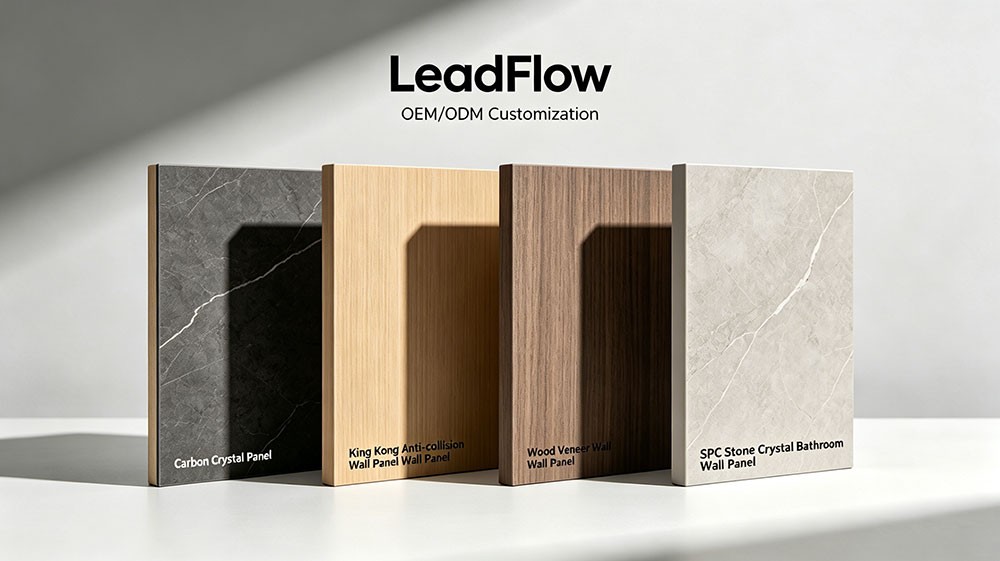
The SPC wall panel sector is entering a consolidation phase. As production capacity has multiplied, price-only competition has compressed margins for undifferentiated factories, pushing the industry toward two visible trends. The first is customization: wholesale buyers increasingly expect OEM and ODM services — proprietary colors, custom widths, private-label packaging, and rapid sampling — as standard terms rather than exceptions. The second is compliance: tightening VOC and fire regulations in major markets will reward factories with certified formulations and penalize those competing purely on price.
For buyers, the implication is clear. The wholesale relationship is shifting from transactional purchasing to supply-chain partnership. Companies that audit their factories, verify certifications independently, build mixed-container programs across SPC, UV marble, and carbon crystal product lines, and negotiate on total landed cost will be better positioned than those chasing the lowest unit price. As interior design continues to favor fast, clean, panel-based finishing, SPC Wall Panel wholesale sourcing will remain one of the highest-leverage decisions in the decorative building materials trade.
FAQ
Q: What exactly is an SPC wall panel made of?
A: An SPC (stone plastic composite) wall panel consists of a rigid core made primarily of PVC resin and calcium carbonate, extruded under heat and pressure, then laminated with a printed decorative film and finished with a UV coating or wear layer. The result is a waterproof, rigid, dimensionally stable panel suitable for interior wall cladding.
Q: What is the typical minimum order quantity for SPC Wall Panel wholesale purchases?
A: Most factories structure MOQs around a full 20-foot or 40-foot container load, or a minimum square-meter quantity per design and color. Some suppliers accept smaller trial orders for stock designs, but customized colors, thicknesses, and packaging usually require container-level volumes.
Q: How are wholesale prices for SPC wall panels calculated?
A: Wholesale quotations are typically driven by panel thickness, core density, edge system, surface treatment, decorative film quality, and order volume, then adjusted for packaging and trade terms such as FOB or CIF. Buyers should compare total landed cost — including freight, duties, and potential claims — rather than the ex-works unit price alone.
Q: How do SPC wall panels differ from WPC wall panels?
A: SPC panels contain a higher proportion of calcium carbonate, making them denser, more rigid, and better suited to water-exposed and high-impact walls. WPC panels incorporate wood fiber, making them lighter and more workable — which is why fluted and slatted decorative profiles are commonly produced as WPC fluted wall panel formats rather than in SPC.
Ready to elevate your next project? Get free samples today and experience the quality firsthand.