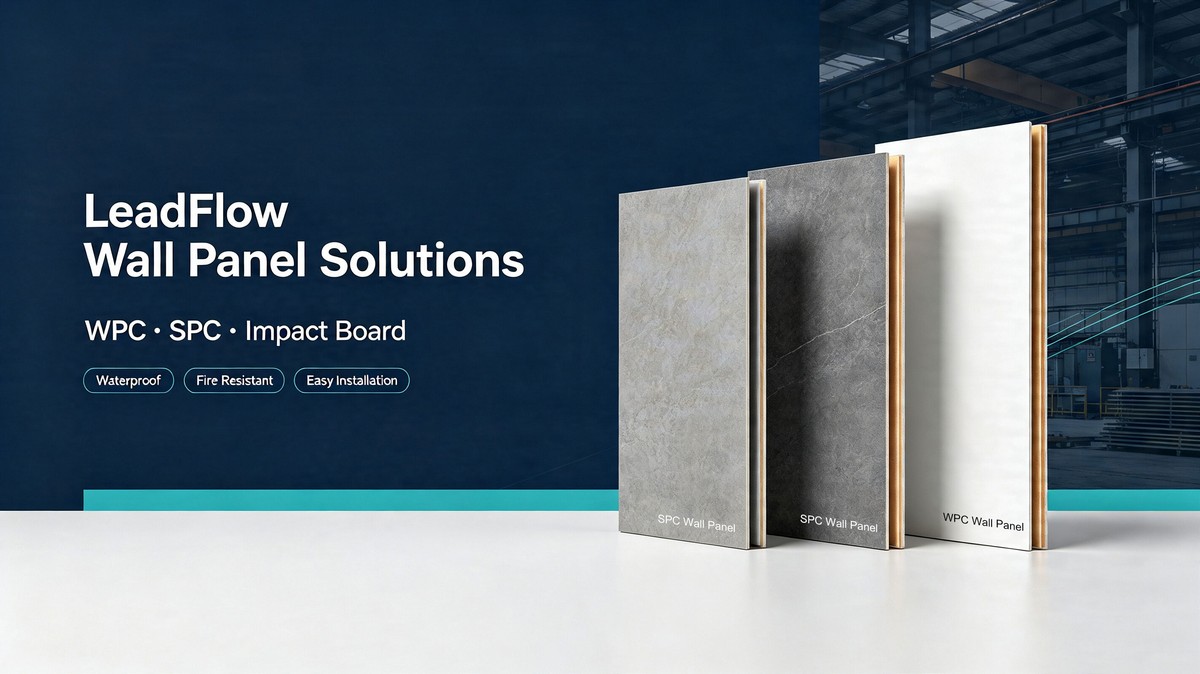
As global construction markets shift from price-driven procurement to carbon-driven decision-making, the WPC wall panel has moved from the sidelines of interior finishing to the center of the green building debate. Developers, architects, and regulators increasingly judge wall cladding not only on appearance and unit cost but on its full life cycle carbon footprint — the greenhouse gas emissions generated from raw material extraction through manufacturing, transport, installation, service life, and end-of-life recovery. For an industry whose core products are built from recycled wood fiber and polymers, this shift is less a threat than a structural advantage. This report examines how life cycle thinking is reshaping the WPC wall panel sector, what it demands from manufacturers and buyers, and where the low-carbon building materials market is heading next.
Key Takeaways
• Most of a WPC wall panel's lifetime carbon emissions are locked in during raw material sourcing and production, making recycled content the single most powerful lever for footprint reduction.
• Environmental Product Declarations (EPDs), governed by ISO 14025 and EN 15804, are becoming a de facto passport for wall panel products in regulated and green-public-procurement markets.
• Durability, minimal maintenance, low transport weight, and end-of-life recyclability give WPC wall cladding a strong cradle-to-grave profile compared with ceramic tile, natural stone, and painted finishes.
• Competition is shifting from price sheets to verified carbon data, rewarding manufacturers and distributors who invest in transparency and circular design.
Why Life Cycle Carbon Footprint Has Become the Industry's Defining Metric
The life cycle carbon footprint of a building product is the total quantity of greenhouse gas emissions associated with that product across every stage of its existence, typically expressed in kilograms of CO2-equivalent. In professional practice it is measured through a life cycle assessment (LCA), which breaks a product's life into standardized modules: A1–A3 covering raw material supply, transport to the factory, and manufacturing; A4–A5 covering delivery and installation; B stages covering the use phase, including cleaning, repair, and replacement; C stages covering demolition and disposal; and module D covering potential benefits beyond the system boundary, such as recycling credits.
Three forces have pushed this methodology from technical annexes into boardrooms. First, regulation: whole-life carbon reporting is being phased into building codes across Europe and is spreading through green public procurement rules in North America, the Middle East, and Asia-Pacific. Second, certification: schemes such as LEED and BREEAM award credits for products backed by verified environmental data, which quietly turns documentation into a sales asset. Third, arithmetic: as operational emissions fall through better insulation and cleaner energy grids, the embodied carbon of construction and fit-out materials represents a growing share of a building's total footprint. Interior finishes are a clear example — a wall panel generates almost no operational emissions of its own, so essentially all of its impact is embodied. That makes the production stage decisive and explains why material selection has become a frontline climate strategy rather than a cosmetic one.
For a WPC Wall Panels supplier, the implication is direct: the ability to document — not merely claim — a low-carbon profile is fast becoming a condition of entry into specification-driven projects, franchise retail rollouts, and government-backed housing programs.
How WPC Wall Panel Production Lowers Carbon Across the Life Cycle
WPC wall panels start life with a structural head start in the LCA because their principal ingredients are, by design, waste streams repurposed. Wood fiber and wood flour are commonly recovered from sawmill residue, furniture offcuts, and processing scrap, while the polymer fraction — HDPE, PVC, or polypropylene — increasingly comes from recycled post-industrial or post-consumer sources. Substituting virgin material with recovered fiber and plastic directly avoids the emissions embedded in logging, petrochemical production, or both, which is why recycled content percentage is the figure most closely scrutinized in an EPD for this product category.
Manufacturing also matters. WPC profiles are formed by extrusion — melting and shaping a compounded blend at moderate temperatures — an altogether lighter industrial process than the high-temperature firing of ceramic tile, the calcination of gypsum plaster, or the quarrying, cutting, and polishing of natural stone. Because the same low-energy process yields everything from flat boards to deep ribbed geometries, a versatility reflected across the spectrum of WPC fluted wall panel design options, manufacturers can serve diverse aesthetics without multiplying process emissions. Lightweight panels also cut transport emissions per square meter, a benefit that compounds on long-haul export routes where a single container of panels covers far more wall area than an equivalent weight of tile or stone.
The use phase is where WPC's story becomes genuinely distinctive. A quality composite panel with a co-extruded polymer skin resists moisture, insects, rot, and UV degradation, carrying a service life commonly measured in decades with nothing more than routine cleaning. There is no repainting cycle, no grout to replace, no periodic refinishing — each avoided maintenance event is an avoided shipment of paint, adhesive, or replacement material, and each avoided replacement multiplies the savings across a building's life. At end of life, the thermoplastic matrix means the material can, in principle, be granulated and re-compounded into new profiles, closing the loop on which the industry's circular economy ambitions depend. Honest caveats remain: collection and recycling infrastructure for composite construction products is still maturing in many regions, and module D benefits are only realized when systems exist to capture them — a point transparent manufacturers now acknowledge openly rather than gloss over.
For buyers comparing decorative finishes, the practical conclusion is that a WPC wall panel's carbon case rests on four verifiable pillars: high recycled content, low-energy forming, long low-maintenance service life, and end-of-life recyclability.
From EPDs to Procurement: What Buyers Should Now Demand
Verified data, not slogans, separates genuine low-carbon products from greenwashed ones. The single most important document is the Environmental Product Declaration — a third-party verified report under ISO 14025, aligned with EN 15804, that quantifies a product's impacts per declared unit, including its global warming potential across the life cycle modules. Alongside the EPD, serious procurement teams ask for recycled-content statements, VOC emission test reports that address indoor air quality (sustainability, after all, includes occupant health — a topic covered in depth in guides to low-VOC interior wall panel certifications), manufacturing energy disclosures, and evidence of take-back or recyclability pathways.
This scrutiny is spreading through every channel of the decorative panel trade. Distributors and SPC Wall Panel wholesale buyers are beginning to embed carbon-disclosure clauses into supply agreements, mirroring practices already common in flooring and furniture. The same questions travel across adjacent categories: a responsible UV Marble Sheet manufacturer now faces parallel requests regarding substrate sourcing, plant energy mix, product longevity, and end-of-life handling, because interior designers increasingly specify whole schemes — wall panels, decorative sheets, ceiling systems — as a single carbon budget rather than item by item.
The result is a procurement checklist that would have looked unusual five years ago and is rapidly becoming standard: request the EPD and read the A1–A3 figures, compare declared service life rather than catalog claims, confirm what share of the polymer and wood fractions is recycled, and ask directly whether offcuts and demolished panels can be returned or reprocessed. Suppliers who answer fluently — and whose documents match their marketing — will find themselves shortlisted not for one project but for framework agreements and multi-year supply programs.
Conclusion and Outlook: Carbon Data Is the New Competitive Frontier
The greening of the wall panel industry is no longer a story about marketing imagery of forests and leaves; it is a story about kilograms of CO2-equivalent, verification bodies, and procurement clauses. The WPC wall panel enters this era with genuine advantages — recycled feedstocks, energy-lean extrusion, decades of maintenance-free service, and theoretical recyclability — but advantages only convert into market value when they are measured, documented, and disclosed. Looking ahead, expect digital product passports in Europe, carbon labeling schemes in other regions, rising recycled-content floors in public procurement, and steady innovation in bio-based polymers and additives. Manufacturers who invest in LCA capability and renewable energy at the plant, and distributors who curate transparent product lines, will define the next decade of the category. In a market where every square meter of wall carries a carbon signature, the winners will be those who can prove — with third-party data — that their products lighten the built environment's footprint.
FAQ
Q: What is the life cycle carbon footprint of a WPC wall panel?
A: It is the total greenhouse gas emissions associated with the panel across all life cycle stages — raw material sourcing, manufacturing, transport, installation, use, and end of life — usually expressed in kilograms of CO2-equivalent per square meter and disclosed in an Environmental Product Declaration.
Q: Why are WPC wall panels considered a sustainable building material?
A: They typically combine recycled wood fiber with recycled plastics, are formed through energy-efficient extrusion, are lightweight to transport, require virtually no maintenance over a long service life, and can be granulated and re-compounded into new products at end of life.
Q: What is an EPD and why does it matter when sourcing wall panels?
A: An Environmental Product Declaration is a third-party verified document (ISO 14025, aligned with EN 15804) that reports a product's environmental impacts, including its carbon footprint, allowing buyers to compare products on audited data rather than marketing claims.
Q: How can I verify a supplier's sustainability claims before ordering?
A: Request the EPD, recycled-content certification, VOC emission test reports, and manufacturing energy disclosures; prioritize suppliers whose published data is product-specific and independently verified, and who can explain recycling or take-back options for offcuts and end-of-life material.