For decades, interior walls played a supporting role — painted, papered, and largely forgotten once the furniture was arranged. That hierarchy has quietly reversed. Across residential, hospitality, and commercial projects worldwide, the wall itself has become the primary design statement, and few material categories capture this shift better than wood plastic composite. The current generation of WPC wall panel interior design trends is redefining space aesthetics: tactile texture is replacing flat ornament, vertical rhythm is replacing uniform color, and engineered warmth is replacing cold, hard surfaces. For architects, developers, and building-material buyers, understanding where these trends are heading — and what they demand from the supply chain — has become a practical necessity rather than a stylistic afterthought.
The appeal is structural as much as visual. Originally proven outdoors in decking and facade cladding, WPC boards combine wood fiber with polymer to deliver the look and warmth of timber with far greater stability and moisture resistance. Extrusion and lamination technology now allows the same material family to be produced in fluted, slatted, embossed, and high-gloss formats, giving designers a single visual language that can run from a living-room feature wall to a hotel lobby or a retail flagship.
Key Takeaways
• Walls have shifted from flat backdrops to tactile focal points, with texture, vertical rhythm, and natural warmth now central to space aesthetics.
• Leading directions include biophilic wood tones, warm minimalism, fluted geometry, and wall-to-ceiling material continuity.
• Material choice follows function: WPC for warmth and workability, SPC for rigid, moisture-resistant durability, and carbon crystal panels for deep embossed, high-gloss decorative finishes.
• Successful projects depend as much on the supply chain as on design — profile tolerances, batch color consistency, and certification documentation separate professional suppliers from generic stock.
WPC Wall Panel Interior Design Trends Shaping Space Aesthetics
The strongest single force behind today's wall design is biophilic design — the well-documented human preference for natural materials, patterns, and tones. Wood-grain WPC panels answer this demand without the cost, weight, and maintenance burden of solid timber. Deep walnut and warm oak grains dominate living rooms and reception areas, while lighter ash and maple tones brighten bedrooms, clinics, and offices. Because the grain is laminated or co-extruded rather than printed on paper, it resists fading and scratching in high-traffic environments.
Running alongside biophilia is warm minimalism. Instead of stark white walls and cold chrome, designers are choosing restrained palettes — greige, taupe, sand, and muted clay — lifted by a single subtle texture. A barely-ribbed panel or soft linen-embossed surface adds depth without clutter, which is precisely why specifiers keep moving away from paint and wallpaper toward engineered panels in minimalist schemes.
The most visually distinctive trend is fluted geometry. Vertical reeded, slatted, and linear profiles create a play of light and shadow that changes through the day, visually heightens ceilings, and conceals minor substrate imperfections. Fluted feature walls now appear behind beds, sofas, television units, reception desks, and restaurant partitions. Because these profiles demand tight manufacturing tolerances, project buyers increasingly source directly from a WPC Fluted Wall Panels supplier instead of mixing generic stock — a specialized supplier can guarantee consistent ridge depth, spacing, and color across an entire elevation, as outlined in our fluted wall panel selection guide.
A fourth trend extends the panel beyond the feature wall. Designers now wrap the same surface around corners, columns, alcoves, and increasingly across ceilings, producing a continuous, enveloping material experience. This continuity reads as craftsmanship, softens acoustics in hard-surfaced rooms, and gives compact urban interiors a sense of intentional calm.
Material Innovation: How SPC and Carbon Crystal Panels Expand the Design Palette
Trends set the direction; materials decide what is buildable. The wall panel market has evolved into a layered system of composites, each optimized for a different balance of warmth, strength, and surface effect.
WPC — wood plastic composite — remains the category's warm, lightweight workhorse. It cuts, routes, and fixes easily, takes wood-grain lamination beautifully, and suits bedrooms, living areas, ceilings, and dry commercial zones.
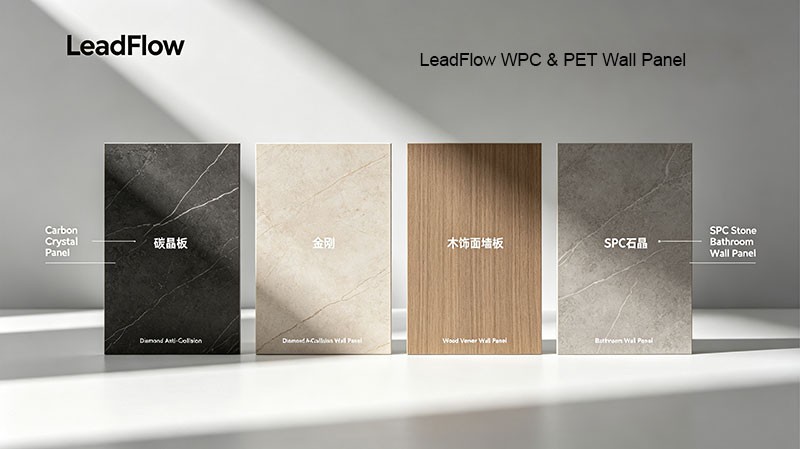
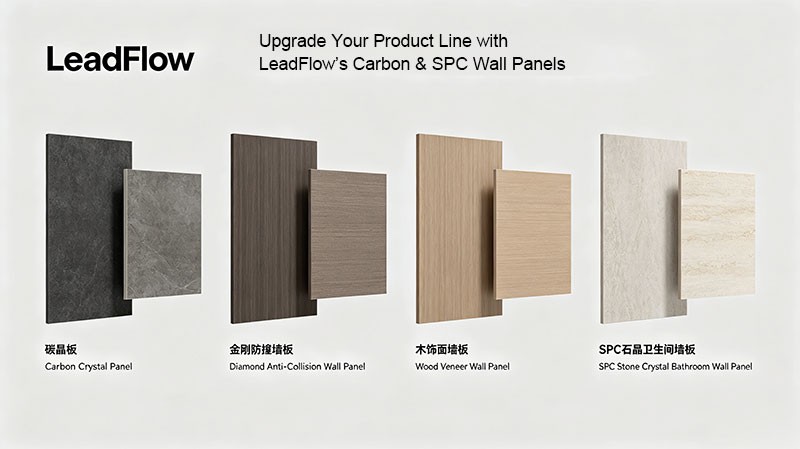
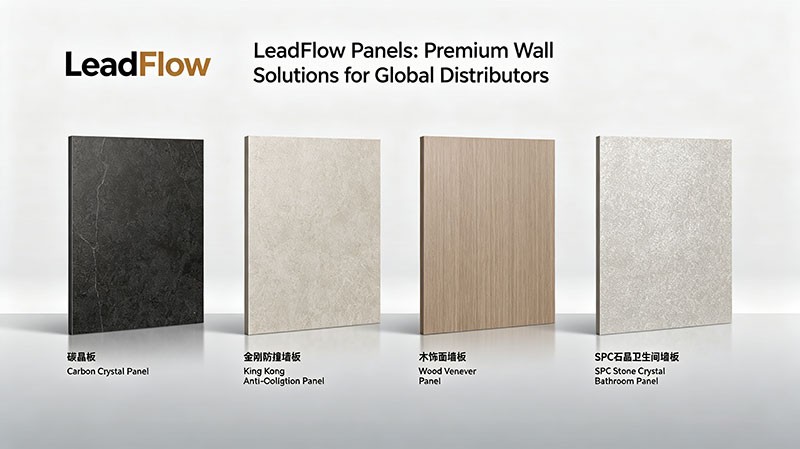
SPC — stone plastic composite — pairs the polymer matrix with a mineral-filled, high-density core. The result is a rigid, dimensionally stable panel with markedly better impact resistance and moisture performance, which is why it is specified for bathrooms, kitchens, corridors, and high-traffic commercial interiors. Denser core, fewer failures: the cause-and-effect relationship is direct. For residential developers and fit-out contractors working at scale, procurement through SPC Wall Panel wholesale channels helps lock in batch-to-batch consistency and volume pricing when hundreds of rooms must match exactly.
At the decorative end sits the carbon crystal panel, a dense polymer composite engineered specifically for surface expression. A technically capable Carbon Crystal Wall Panel factory can pair precision embossing with UV-cured lacquer lines to deliver deep marble veining, high-gloss or matte stone effects, and fine textured grain at a fraction of natural stone's weight, cost, and installation burden. For hospitality and retail projects that want the drama of marble without the structural reinforcement it demands, this category has become the default answer.
In practice, the three materials are complements, not competitors. A single hotel project may use WPC fluted cladding in guest rooms, SPC panels in wet corridors, and carbon crystal marble-effect surfaces at the reception — a combination explored in detail in our WPC, SPC, and carbon crystal panel comparison. The specifier's task is matching each zone's traffic, humidity, and visual ambition to the right composite.
Specifying Panels: Scale, Light, Sustainability, and Supply-Chain Fit
Good outcomes depend on proportion and light as much as product choice. Narrow flutes read elegant and contemporary in compact rooms, while wider slats suit grand lobbies and double-height spaces. Directional and grazing light amplifies surface relief dramatically, so heavily textured panels near windows or sconces deserve matte finishes to avoid glare, whereas high-gloss carbon crystal surfaces perform best where controlled lighting can be designed around them.
Sustainability has moved from marketing language to procurement criteria. Composite panels extend service life through dimensional stability and scratch resistance, eliminating the repainting and re-papering cycles of conventional finishes, and many production lines now incorporate recycled wood fiber and polymer content. Buyers should still verify what matters for their market: fire performance data, low-emission documentation, and conformity with local building codes such as CE marking in Europe. A durable panel that never needs replacement is often the most sustainable choice available.
Finally, sourcing discipline determines whether the design intent survives installation. Professional buyers request samples from the actual production batch, confirm profile and thickness tolerances, check color consistency under both daylight and artificial light, and align the panel system with the intended fixing method — batten and clip systems for fluted profiles, adhesive systems for flat laminated panels. Suppliers who offer custom tooling and finish development increasingly act as design partners rather than commodity vendors, especially on branded hospitality and retail rollouts.
Conclusion: Wall Surfaces Become the Language of Space
The evolution of the wall panel reflects a broader truth about contemporary interiors: people no longer judge a space by its furniture alone, but by how its surfaces feel, sound, and age. WPC wall panel interior design trends will keep converging around texture, natural warmth, and material honesty, while the expanding palette of composites gives that vision a manufacturable backbone. Looking ahead, expect digital surface printing to enable truly custom art walls, deeper integration between design software and factory tooling to shorten the path from render to installation, and circular material strategies to become a procurement requirement rather than a differentiator. For manufacturers, suppliers, and buyers alike, the walls are no longer the background of the industry. They are the product.
FAQ
Q: What are the leading WPC wall panel interior design trends?
A: The dominant directions are texture-led surfaces — especially fluted and slatted profiles — biophilic wood-grain finishes in warm natural tones, warm minimalism with subtle embossed texture, and wall-to-ceiling material continuity that wraps panels around corners and ceilings.
Q: Can WPC wall panels be used in bathrooms and other humid spaces?
A: Yes. WPC and SPC cores offer far better moisture resistance than plywood or MDF, and SPC panels in particular perform well in wet zones. Panels should still be kept out of standing water, installed with sealed trims, and paired with adequate ventilation for long-term performance.
Q: How do WPC, SPC, and carbon crystal wall panels differ?
A: WPC combines wood fiber with polymer for a warm, lightweight, easy-to-work panel suited to dry living spaces. SPC uses a mineral-filled rigid core for superior impact and moisture stability in kitchens, bathrooms, and commercial areas. Carbon crystal panels are dense polymer composites engineered for deep embossing and high-gloss marble-effect finishes.
Q: What should buyers check when sourcing wall panels in bulk?
A: Key checkpoints include batch-to-batch color consistency, profile and thickness tolerances, surface abrasion and light-fastness performance, fire and low-emission documentation aligned with local building codes, and the supplier's ability to customize profiles and finishes for the project.
Want to see more options? Download our full product catalog and find the perfect solution for your needs.