
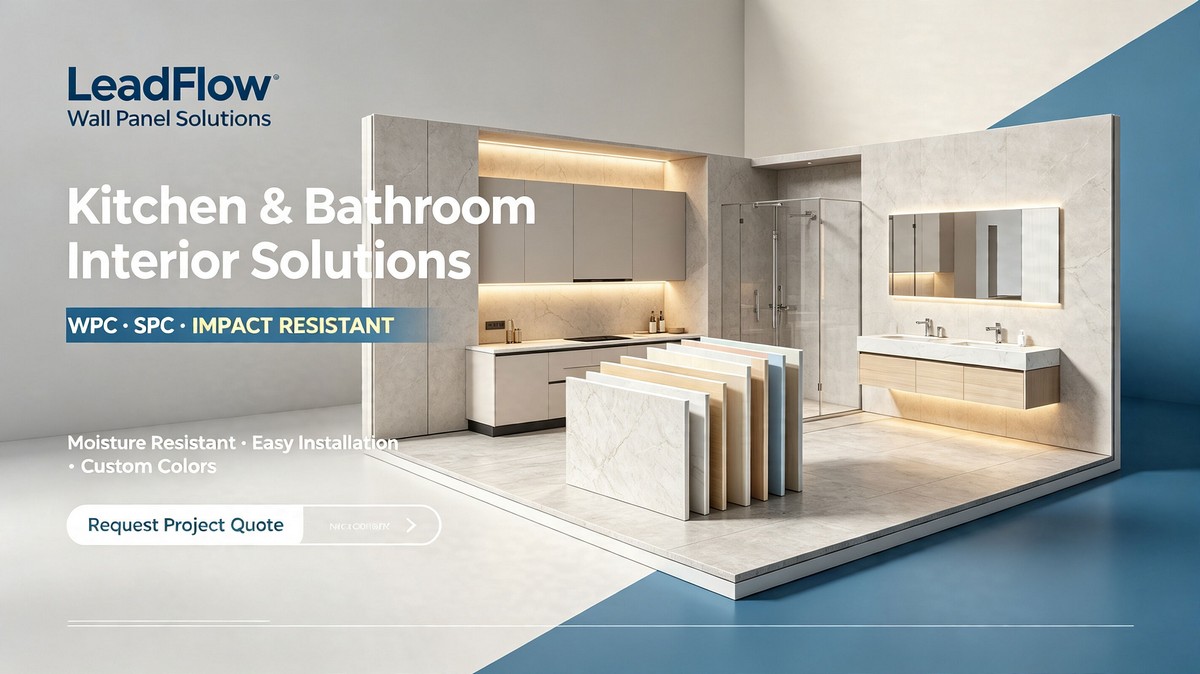
Behind every decorative wall panel sits a decision most buyers never see: the core. In today's interior finishing market, the comparison of WPC vs. SPC core materials has become the single most consequential technical conversation between specifiers, distributors, and manufacturers. Two panels can look nearly identical on a showroom wall — the same marble print, the same fluted texture, the same matte finish — yet behave entirely differently once installed on a humid bathroom partition or a high-traffic hotel corridor. This deep dive examines what separates the wood-plastic composite core from the stone-plastic composite core, how each performs under real project conditions, and what buyers should verify before committing to a supplier.
Key Takeaways
• A WPC core blends wood fiber with thermoplastic resin, producing a lighter panel with a warm, wood-like feel that excels in decorative interior walls.
• An SPC core combines calcium carbonate with PVC resin, delivering a denser, more rigid board with superior impact and dimensional stability.
• Neither core is universally better: moisture exposure, traffic level, and design intent should drive the material decision.
• Supplier due diligence — density specifications, fire certifications, and batch-to-batch consistency — is the most reliable safeguard when purchasing in bulk.
Understanding the Core: What WPC and SPC Are Made Of
The fundamental difference between WPC and SPC wall panels begins with their formulation. Wood-plastic composite (WPC) is produced by blending wood flour or natural plant fiber with thermoplastic resin — most commonly PVC or PE — together with stabilizers, lubricants, and in many cases foaming agents. The mixture is extruded into solid or hollow profiles, which is why a WPC wall panel often feels noticeably lighter and cuts more easily on site than its stone-based counterpart. The fibrous structure also gives WPC a warmer tactile quality and a subtler, more natural sound when tapped.
Stone-plastic composite (SPC), by contrast, is dominated by calcium carbonate — finely ground limestone powder — bound with PVC resin and process additives. The mineral-heavy recipe yields a board with high density, excellent flatness, and strong resistance to indentation. The technology was commercialized in rigid flooring before migrating to vertical surfaces, where SPC wall panels now compete directly in the decorative segments that WPC serves. Modern SPC panels typically receive a printed decorative film sealed under a UV-cured coating, giving them the high-gloss marble and slate looks that remain popular in commercial interiors.
Surface technology further differentiates the two families. WPC fluted profiles rely on precision extrusion tooling to keep groove geometry crisp from batch to batch, while co-extruded outer layers add scratch resistance and color stability. SPC panels depend more heavily on lamination and UV coating quality, which is why coating hardness and film adhesion are recurring inspection points for stone-core buyers. Because formulation and surface engineering vary so widely between factories, panels sourced from one WPC Wall Panels supplier can feel and wear noticeably differently from another's despite identical catalog descriptions — a practical reason why physical samples matter far more than specification sheets alone.
WPC vs. SPC Wall Panels: Performance Head-to-Head
When the two cores are measured against the criteria that decide real projects, each material wins in a different environment rather than one dominating across the board.
Density and weight. SPC is the denser of the two, which translates into better dent resistance and a more solid feel, but also higher shipping weight and more demanding handling. WPC's lighter body reduces structural load, simplifies installation on adhesive or clip systems, and cuts freight cost — a meaningful advantage for cross-border wholesale orders.
Moisture behavior. Both cores are, in principle, waterproof, because neither wood fiber nor stone powder absorbs water the way cellulose-based boards do. In practice, however, hollow WPC profiles should have cut edges sealed and cavities behind panels kept ventilated. SPC's impervious mineral core makes it the default recommendation for bathrooms, commercial washrooms, and food-service interiors.
Dimensional stability. The mineral content of SPC limits thermal expansion, allowing longer runs of panel with fewer movement joints. WPC formulations have improved considerably, but installers still plan for expansion gaps on extended walls, especially in climates with wide seasonal temperature swings.
Fire performance. Both materials are PVC-based systems, and flame-retardant formulations are widely available; many products in each family are engineered to meet European Class B fire requirements for interior wall cladding. The essential point for buyers is that fire certificates must be requested per product and per batch, because classification applies to a specific formulation, not to the material category as a whole.
Acoustics and feel. The slightly porous, fibrous structure of WPC damps vibration and softens impact noise, which is one reason fluted WPC is favored in residential feature walls and hotel headboard walls. SPC's mass also helps block sound, and its rigidity delivers a solid, ceramic-like touch.
Cost and lifecycle. WPC usually carries a lower unit cost and a lighter logistics burden for decorative interior use, while SPC's durability in high-traffic or impact-prone zones can reduce replacement frequency over the life of a building. Specifiers should therefore benchmark price against expected service life and the dominant failure modes of the installation environment, not simply against the per-square-meter figure. For detailed execution planning, many project teams also consult a wall panel installation guide before finalizing the material list.
Sourcing Perspective: Matching Core Material to Market and Application
Material selection ultimately comes down to matching core characteristics to the realities of each market segment, and this is where supplier capability matters as much as chemistry.
For residential feature walls, TV background walls, and hospitality ceilings, WPC fluted designs remain the flagship category, and fluted panel design trends keep expanding beyond classic wood tones into painted, two-tone, and wide-groove finishes. A professional WPC Fluted Wall Panels supplier should demonstrate three capabilities: consistent groove geometry across long production runs, a dependable color-matching system for wall-to-ceiling continuity, and co-extruded or well-laminated surfaces that resist fading in daylight-exposed rooms. Groove crispness is a surprisingly effective quality indicator — soft or rounded grooves usually signal worn tooling or unstable extrusion parameters.
For high-traffic commercial projects, wet areas, and renovation overlays over imperfect substrates, SPC tends to justify its premium. Buyers working through SPC Wall Panel wholesale channels typically concentrate on density tolerance within a production batch, edge strength during palletized transport, and the hardness of the UV coating, since chipped edges and dull surfaces are the most common reasons for rejected containers. Wholesale purchasing also rewards suppliers who can provide third-party test reports covering fire classification, formaldehyde and VOC emissions, and heavy-metal content in pigments.
A practical due-diligence checklist for either material should include requesting cross-section samples rather than relying on surface photographs, comparing density data sheets between quoted offers, inspecting packaging standards for ocean freight, and auditing consistency between the approval sample and the first production batch. Distributors who skip these steps frequently discover quality drift only after installation complaints arrive from end customers.
Conclusion and Outlook
The WPC versus SPC question is not a contest with a single winner but a mapping exercise between material science and application. WPC brings lightness, warmth, design flexibility, and cost efficiency to decorative interiors; SPC brings density, rigidity, and resilience to demanding commercial and moisture-heavy environments. Looking ahead, the boundary between the two families is expected to blur: co-extrusion and improved formulations are narrowing the performance gap, bio-based and high-recycled-content cores are advancing under sustainability pressure, and printing technology keeps expanding the aesthetic options for both. Buyers who understand what sits beneath the surface — and who verify it with samples, certificates, and supplier audits — will consistently outperform those who choose by price tag or surface appearance alone.
FAQ
Q: What is the main difference between WPC and SPC wall panels?
A: WPC cores combine wood fiber with thermoplastic resin, making the panel lighter with a warmer feel, while SPC cores combine calcium carbonate with PVC resin, producing a denser, more rigid board with higher impact resistance and dimensional stability.
Q: Are WPC wall panels suitable for bathrooms and other humid spaces?
A: Yes, because the plastic matrix does not absorb water. Cut edges of hollow profiles should be sealed, cavities behind panels should stay ventilated, and direct standing water should be avoided. Under those conditions WPC performs well, though SPC remains the more common default for heavy wet zones.
Q: Which core material is more cost-effective in the long run?
A: It depends on the application. WPC typically offers a lower upfront cost and cheaper logistics for decorative interior walls, while SPC's durability in high-traffic or impact-prone areas can lower total cost of ownership by reducing repair and replacement frequency.
Q: How can buyers verify core quality before bulk purchasing?
A: Request physical cross-section samples, review density specifications plus fire and VOC certifications for the exact product, compare first-batch output against the approved sample, and confirm export-grade packaging standards to prevent transit damage.
Ready to elevate your next project? Get free samples today and experience the quality firsthand.








