In decorative building materials, the surface sells the product long before performance data enters the conversation. For distributors, designers, and contractors sourcing across global manufacturing hubs, the quality of WPC wall panel surface treatment has become the clearest indicator of a factory's true capability. The composite core determines strength and moisture resistance, but it is the surface—the fidelity of the wood grain, the depth of the embossing, the hardness of the coating—that decides whether a panel reads as premium cladding or commodity product. This report examines the principal surface treatment processes used in WPC wall panel production, the customization capabilities that separate leading manufacturers from trading intermediaries, and the practical checks global buyers should apply before committing to a supply partner.
Key Takeaways
Surface treatment drives perceived value. Wood grain transfer, UV coating, film lamination, and synchronized embossing account for most of the visible quality gap between premium and commodity WPC wall panels.
Customization is a process capability, not a slogan. Genuine flexibility shows up in color matching, custom profile tooling, adaptable minimum order quantities, and disciplined sample approval workflows.
Shared finishing infrastructure supports multi-category sourcing. The UV coating and lamination lines that finish wall panels also serve marble-look sheet production, which is why many buyers assess any WPC wall panels supplier for consolidated sourcing across categories.
Quality control should be process-based. Adhesion, color consistency, gloss uniformity, and yellowing resistance can all be verified with simple, repeatable tests before a bulk order is placed.
WPC Wall Panel Surface Treatment: The Core Processes Explained
Modern production relies on a small set of mature finishing methods, each producing a distinct aesthetic and performance profile. Understanding how these processes differ is the foundation of any sourcing decision, because cost, durability, and customization latitude all follow from the finishing method chosen.
Heat transfer and hot stamping remain the workhorse of the industry. A carrier film printed with wood grain, marble, fabric, or abstract patterns is pressed against the panel under controlled heat and pressure, fusing the decorative layer directly onto the substrate. The method delivers high pattern fidelity at high line speed, which is why it dominates fluted and slatted panel production. Its main constraint is pattern latitude: factories are generally limited to the film libraries they hold or can commission, so truly bespoke designs require custom film runs with corresponding minimum volumes.
UV coating builds a hard, cured lacquer layer on the panel surface using roller application followed by near-instant curing under ultraviolet lamps. Because multiple passes can be layered, the process supports high-gloss, matte, and super-matte finishes with strong scratch, stain, and chemical resistance. The same technology underpins marble-look sheets, and a capable UV marble sheet manufacturer typically runs multi-roller coating lines with precise film-thickness control. For wall panels, UV finishes are increasingly specified for commercial interiors where cleanability is a priority.
Film lamination bonds a pre-printed PVC or PET decorative film to the panel with adhesive, usually through hot-press or cold-press lamination. Compared with transfer printing, laminated films are thicker and can carry deeper embossed texture and larger pattern repeats, making the process attractive for large-format marble and stone effects. Adhesive quality and film thickness, rather than the pattern itself, determine long-term peel resistance—both points worth verifying during supplier audits.
Embossing and in-mold texturing shape the surface physically rather than decorating it. Engraved rollers or calibrated dies press the fluted geometry, wood pore texture, or linen grain into the panel during or immediately after extrusion. Synchronized embossing, where the texture aligns with the printed grain, is regarded as a premium capability because it requires accurate registration between the decorative layer and the tooling. For fluted profiles, the tooling essentially is the product: a WPC fluted wall panels supplier with in-house mold-making can deliver custom rib widths, depths, and rhythms, while one dependent on outsourced tooling cannot.
Spray coating and digital printing round out the landscape. Spray-applied primers and topcoats enable custom solid colors, metallics, and gradient effects on shorter runs, while industrial digital printing—still emerging in this sector—opens the door to murals, brand graphics, and one-off art panels without film tooling. As digital lines mature, they are expected to compress the minimum viable order for fully bespoke designs.
Because every decorative and protective function sits in the surface layers, the durability of a finished panel is governed almost entirely by its coating system, not by the composite core beneath it. That single fact explains why the choice of WPC wall panel surface treatment has become the decisive battleground among manufacturers.
Customization Capabilities: Where Manufacturers Distinguish Themselves
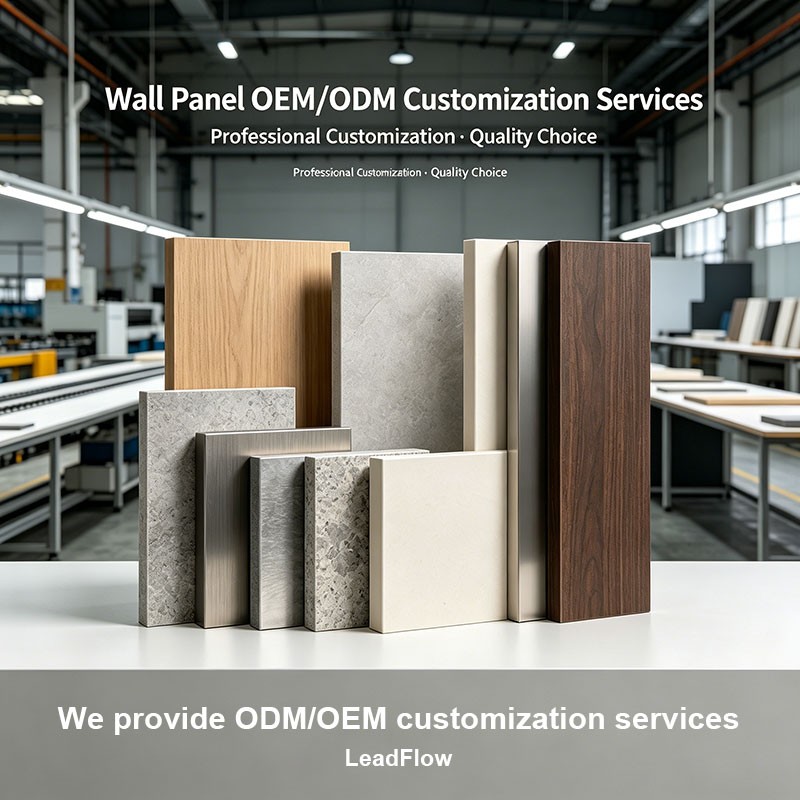
Customization in this industry is not a marketing claim but a measurable set of process capabilities. The factories that lead in custom work share four characteristics: controlled color management, in-house tooling, disciplined sampling, and flexible batch economics.
Color management comes first. Professional operations maintain archived color libraries and can match a physical sample, a standard color reference, or a digital file, then verify the match under standardized lighting before production. Batch-to-batch color consistency—often quantified through color-difference tolerance—is what protects a distributor's shelf appearance across repeat orders. Suppliers who cannot state their color tolerance numerically are signaling reliance on visual judgment alone.
Tooling and profile development define what is possible with fluted and three-dimensional geometries. Developing a new fluted profile involves mold design, extrusion trials, and surface registration adjustments, which is why lead times for custom profiles typically run several weeks. Established manufacturers frequently offer exclusive profile agreements, giving a regional distributor defensible product differentiation rather than a widely copied catalogue shape.
Sampling discipline is the third pillar. A structured workflow—express sample, internal inspection, customer approval, and retention of a sealed golden sample for every production batch—converts customization from a risk into a routine. Buyers should treat the presence or absence of golden-sample retention as a quick litmus test of a factory's quality culture.
Batch economics determine whether customization is practical for a given project size. Standard colors and existing film patterns can usually run at low minimum order quantities, while custom films, custom tooling, and special coatings carry higher thresholds because they consume machine time and materials regardless of volume. Transparent communication about these thresholds—before quotation—prevents most of the friction seen in custom projects.
Consolidation is also reshaping expectations. Many buyers now prefer to source complementary categories—fluted WPC panels, UV marble sheets, and charcoal or SPC wall boards—from a single partner to reduce freight cost, harmonize color across a project, and consolidate quality control. Suppliers who operate multiple finishing technologies on one floor are naturally positioned for this role, and buyers can explore a fluted wall panel installation guide or an overview of marble-look alternatives to see how such assortments fit together.
Evaluating Surface Quality: A Practical Checklist for Global Buyers
Surface defects are the leading cause of rejected wall panel shipments, and nearly all of them can be screened before goods leave the factory. A process-based checklist outperforms any certificate folder.
Buyers should verify, at minimum: color consistency across production batches under standardized light; coating adhesion, using a simple cross-hatch or peel test on laminated and transfer surfaces; gloss uniformity, viewed at a raking angle to reveal orange peel or roller marks; scratch and stain resistance, tested with common household and cleaning agents for commercial specifications; and yellowing resistance, particularly for panels installed near windows or under strong artificial light. Supporting documentation—fire performance reports such as EN 13501-1 classifications or ASTM E84 results, and VOC or formaldehyde emissions data—should correspond to the exact surface system being quoted, not to an older product version.
Transparency practices matter as much as test results. Reputable manufacturers permit live video inspections of finishing lines, retain golden samples for mutual reference, and document surface specifications—coating type, film thickness, gloss level—on every order confirmation. Buyers planning large or brand-critical projects should also ask how the factory isolates color and texture risk during ramp-up, because the first hours of a production run are where most consistency problems originate.
Conclusion: Surface Capability Will Define the Next Competitive Cycle
The WPC wall panel market is shifting from substrate competition to surface competition. Formulation differences in the composite core have narrowed across serious manufacturers, while the surface—its pattern fidelity, coating performance, and customization latitude—now carries the differentiation that buyers actually see and pay for. The near-term outlook points toward wider adoption of digital printing for small-batch bespoke design, low-VOC and waterborne coating systems responding to indoor-air regulations, richer synchronized textures, and tighter integration between wall panels and adjacent categories such as marble-look sheets. For global buyers, the practical conclusion is straightforward: evaluate a potential WPC wall panels supplier the way an engineer evaluates a coating line—by process, tolerance, and traceability—rather than by catalogue imagery. Factories that master surface science and pair it with disciplined customization will set the price benchmarks of the coming cycle; those that compete on surface appearance alone will keep competing on price.
FAQ
Q: What is the most common surface treatment for WPC wall panels?
A: Heat transfer (hot stamping) of a decorative film, usually followed by a protective topcoat, is the most widely used process. UV coating and PVC film lamination are the main alternatives, chosen for higher gloss, deeper texture, or larger pattern repeats.
Q: Can WPC wall panel colors and patterns be customized to match a specific design scheme?
A: Yes. Established factories offer color matching from physical samples or standard color references and can commission custom transfer films or laminate patterns. Custom designs typically require a sample approval round and higher minimum order quantities than catalogue options.
Q: What is the difference between hot stamping and film lamination on wall panels?
A: Hot stamping fuses a thin decorative layer from a transfer film directly onto the panel using heat and pressure, while lamination bonds a thicker PVC or PET film with adhesive. Lamination supports deeper embossing and larger pattern repeats, whereas hot stamping offers efficient high-volume production with excellent pattern detail.
Q: How can I verify surface quality before placing a bulk order?
A: Request golden samples, run basic adhesion (cross-hatch) and stain tests, compare color consistency across at least two production batches under standardized lighting, and ask for fire performance and emissions documentation tied to the exact surface system quoted.
From wood grain transfer to bespoke UV finishes, surface capability is where distinctive interiors begin.
Ready to elevate your next project? Get free samples today and experience the quality firsthand.