
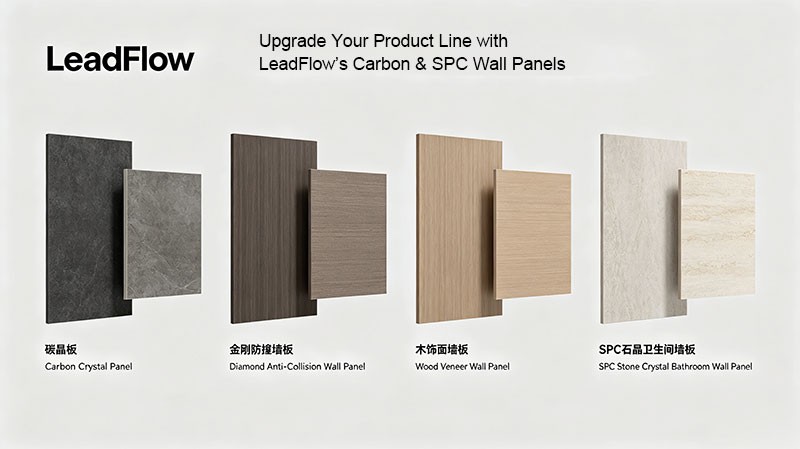
In the decorative wall panel business, the extrusion line decides what a product is, but the finishing line decides whether it sells. WPC wall panel surface treatment — the lamination, coating, and texturing applied to the extruded substrate — now determines how panels look, how long they last, and how much premium a buyer is willing to pay. For any WPC Wall Panels supplier competing in the global market, the workshop conversation has shifted from throughput to the surface line: which decorative films, which coatings, and how quickly a custom order can move from color sample to shipping container. This article examines the leading surface treatment processes, the customization capabilities built around them, and what international buyers should evaluate when auditing a manufacturer.
Key Takeaways
• Surface treatment — laminated decorative film, co-extrusion, UV coating, and embossing — defines a WPC wall panel's appearance, durability, and price tier; the substrate alone no longer differentiates competing products.
• Customization has moved from optional to essential. Color matching, custom profile dimensions, exclusive textures, and flexible minimum order quantities are now baseline expectations for global buyers.
• Co-extruded panels deliver the strongest weathering and peel resistance because the polymer cap is fused to the core, while laminated and UV-coated finishes offer the widest design variety at lower cost.
• Auditing a factory's surface equipment — in-line embossing, digital printing, and an in-house color laboratory — is the fastest way to judge genuine customization capability.
Core WPC Wall Panel Surface Treatment Processes Explained
Four process families dominate WPC wall panel surface treatment today, and each produces a distinct balance of aesthetics, durability, and cost. Understanding how they work — and where they can fail — is the foundation of any serious sourcing decision.
Decorative film lamination. The most widely used process bonds a PVC decorative film or wood-grain paper to the substrate with hot-melt adhesive, increasingly replaced by PUR (polyurethane reactive) adhesive for its superior bond strength and moisture resistance. Lamination offers the broadest design vocabulary in the industry: wood grain, marble, fabric weave, brushed metal, and solid matte colors. Because the decor layer is a pre-printed film, factories can switch designs quickly and hold thousands of patterns available, which is why laminated panels remain the volume workhorse of the interior wall panel market.
Co-extrusion. Instead of gluing a layer on afterward, co-extrusion forms a weatherable cap layer — typically ASA or PMMA acrylic — around the core in a single pass through the die. Because the cap is fused to the substrate rather than bonded with adhesive, there is no glue line to fail, and the cap can be formulated with UV stabilizers for outdoor-grade color retention. The trade-off is a somewhat narrower design range, concentrated in solid colors and wood tones, and a higher unit cost than film lamination.
UV coating and lacquering. UV-cured lacquer is sprayed or roll-coated onto the panel and hardened within seconds under ultraviolet lamps. The process produces high-gloss, super-matte, and scratch-resistant finishes that are difficult to achieve with film, and it is the backbone of premium categories such as UV marble sheets and carbon crystal panels, both of which depend on a hardened decorative layer for their stone-like appearance.
Embossing and texturing. Embossing presses a physical texture into the panel surface, either in-mold during extrusion or via an embossing roller after lamination. Synchronized (in-register) embossing aligns the texture precisely with the printed grain, giving wood-look panels a realistic feel under the fingertips. Deep 3D textures — leather grain, linen weave, stone ripple — have become especially popular on WPC fluted wall panel collections, where shadow lines and tactile depth drive the design statement.
Digital and 3D printing. Still the newest of the processes, direct digital printing allows photographic or fully custom artwork to be applied panel by panel, without the cost of a printed film roll. It is currently positioned as a tool for short runs, sample batches, and bespoke projects rather than mass production.
Customization Capabilities: The New Competitive Battleground
Across the industry, customization capability has become the primary yardstick by which buyers separate commodity extruders from true manufacturing partners. Price and lead time still matter, but the questions procurement teams now ask first concern color labs, tooling, and texture development.
Color matching is the entry point. Established factories maintain an in-house color laboratory equipped with spectrophotometers and film-matching archives, allowing a buyer to submit a Pantone reference or a physical sample and receive a matched decor in days rather than weeks. The same capability extends across material platforms: distributors active in SPC Wall Panel wholesale increasingly ask their panel partners to carry one decor film across WPC, SPC, and rigid PVC ranges, so that a single color family runs consistently through an entire catalog instead of fragmenting into near-miss shades.
Dimensional and profile customization follows the same logic. Standard widths and fluted geometries cover most projects, but hotel groups, design studios, and retail chains routinely request proprietary profile drawings, custom board widths, or project-specific lengths. A factory with its own mold workshop can usually open a new profile in a few weeks; one dependent on external toolmakers adds both time and confidentiality risk to the customer's design.
The upstream equivalent applies to surface-led products. A Carbon Crystal Wall Panel factory with in-house UV coating lines and plate-making capability can turn a custom marble artwork into a sellable SKU within a single production cycle, whereas a plant that outsources its decorative film must wait on the film supplier's schedule and minimum roll quantities. This is why serious buyers now treat surface-line ownership as a core audit item, alongside extrusion capacity and quality certifications.
Customization also reaches packaging and logistics: private-label cartons, barcode labeling, mixed-container loading, and project-specific palletizing have become standard requests, and the ability to handle them smoothly often decides which supplier wins repeat orders even when quoted prices are similar.
Matching Surface Treatment to Application and Budget
Choosing the right surface treatment is ultimately a trade-off between design freedom, mechanical performance, and unit cost — and the correct answer differs by project type.
Because the cap layer is fused rather than glued, co-extruded panels resist delamination in humid or demanding environments such as bathrooms, kitchens, and coastal properties, making them the default recommendation where moisture and sunlight are constant. Because UV-cured lacquer cross-links into a hard, closed surface, UV-coated panels tolerate abrasion and cleaning chemicals well, which suits high-traffic commercial corridors, retail fit-outs, and furniture-look feature walls. Laminated panels, in turn, win on design breadth and cost efficiency, and remain the sensible choice for residential living rooms, bedrooms, and large-volume developments — provided the buyer verifies adhesive quality and edge sealing, the two points where budget lamination most often falls short.
Embossing adds perceived value across all three routes. Texture hides minor substrate imperfections, deepens realism, and justifies premium pricing; the only caution is that very deep textures collect dust in commercial settings and deserve a mention in maintenance guidance. A useful internal reference for buyers comparing decorative surfaces across product categories is our guide to UV marble sheet finishes, which covers many of the same coating principles from the PVC-based side of the market.
The market direction is clear: hybrid surface strategies. Forward-looking factories routinely combine processes — an embossed laminated panel finished with a thin UV topcoat, for example — to capture film-level design freedom with coating-level durability. As buyers become more technically literate, single-process products increasingly compete on price alone, while multi-process panels command the margin.
Conclusion and Outlook
Surface treatment has moved from the end of the production line to the center of the industry's competitive conversation. The next phase will be shaped by mass customization: shorter digital-printing runs, faster color matching, and more flexible tooling will keep narrowing the gap between standard catalog products and custom projects. At the same time, water-based and low-VOC coatings, film-free embossed finishes, and recyclable decor layers are responding to tightening environmental expectations in Europe and North America. For buyers, the practical takeaway is straightforward — when evaluating a manufacturer, spend as much time on the finishing line and the color lab as on the extrusion shop floor, because that is where product differentiation now lives.
FAQ
Q: What surface treatments are commonly used on WPC wall panels?
A: The main processes are decorative film lamination (including wood-grain transfer), co-extrusion with an ASA or PMMA cap layer, UV coating or lacquering, and embossing for textured or synchronized wood-grain surfaces. Many premium products combine two processes, such as an embossed laminated panel finished with a UV topcoat.
Q: Can WPC wall panels be customized in color, texture, and size?
A: Yes. Established manufacturers offer Pantone or sample-based color matching, custom embossing textures, proprietary profile drawings, and project-specific lengths and widths under OEM/ODM terms. Opening a new profile mold typically takes a few weeks, while custom colors can often be sampled within days when the factory has an in-house color lab.
Q: Which surface treatment is the most durable?
A: Co-extrusion generally offers the best long-term durability because the protective cap is fused to the core and contains UV stabilizers, giving excellent weathering and peel resistance. UV-cured lacquers rank close behind for scratch and stain resistance, while laminated surfaces offer the best cost-to-design ratio but depend heavily on adhesive quality.
Q: How should I evaluate a supplier's customization capability?
A: A capable WPC Wall Panels supplier should have in-house surface lines (lamination, UV coating, or co-extrusion), an internal color laboratory, mold development capacity, documented adhesion and abrasion testing, and the flexibility to handle small pilot batches before mass production. A factory tour or video audit focused on these areas reveals more than any catalog.
Looking for competitive pricing? Request a quote now and let us help you source the right materials.








