
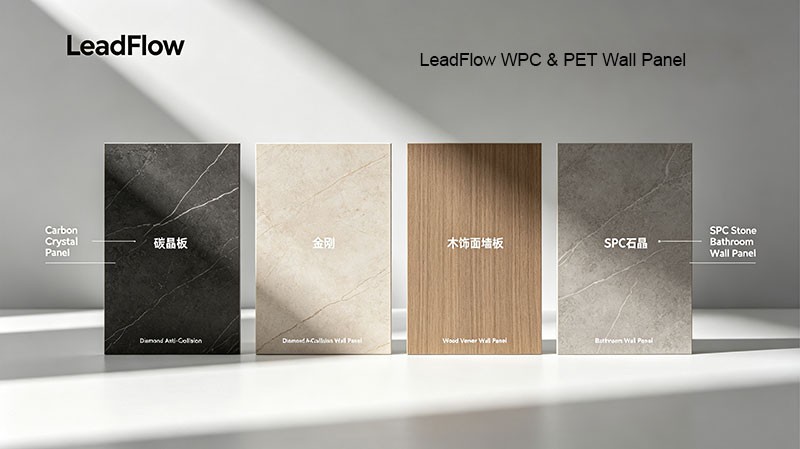
In the global decorative wall panel market, two acronyms dominate every purchasing conversation: WPC and SPC. Yet distributors, contractors, and designers routinely specify these products without a clear picture of what actually separates them. The real difference between WPC vs SPC wall panels is not the printed wood-grain film or the marble-effect finish on the surface — it is the chemistry and density of the core. Understanding that core is the key to predicting how a panel will handle moisture, impact, temperature, and time, and it is the single most reliable way to compare quotations that look identical on paper but behave very differently on site.
Key Takeaways
• WPC (wood-plastic composite) cores blend wood flour or plant fiber with thermoplastics such as PVC or HDPE, producing a lighter panel with good machinability and a warm decorative character.
• SPC (stone-plastic composite) cores fuse PVC resin with a high proportion of calcium carbonate, delivering higher density, rigidity, and dimensional stability.
• Moisture resistance, impact strength, weight, and fastening methods all trace back to the core formulation rather than the surface décor.
• Neither core is universally superior: WPC suits decorative interior cladding where weight and workability matter, while SPC excels in high-humidity and high-traffic environments.
What Defines the Core: WPC and SPC Composition Explained
The defining difference between WPC and SPC wall panels lies beneath the decorative layer, in the extruded core that determines nearly every performance attribute.
Wood-plastic composite (WPC) is a hybrid material in which wood flour, wood fiber, or rice-husk particles are compounded into a thermoplastic matrix — most commonly PVC or HDPE — together with stabilizers, lubricants, and foaming agents. In wall panel production, the organic content typically falls somewhere between roughly one-third and two-thirds of the formulation, depending on the product line and target price point. The result is a core that behaves much like engineered timber: it can be routed, grooved, and screwed with ordinary woodworking tools, which is precisely why so many fluted, slatted, and three-dimensional relief profiles on the market are made from WPC.
Stone-plastic composite (SPC) replaces the organic filler with an inorganic mineral — most often calcium carbonate, or finely ground limestone — bound in a PVC matrix. Because the filler is mineral rather than cellulosic, SPC cores are markedly denser and heavier than WPC; a comparable profile commonly weighs around twice as much. The stone-to-polymer ratio is the single most influential variable in SPC quality. More resin improves flexibility and screw-holding power; more stone improves surface hardness and lowers raw-material cost, but pushes the panel toward brittleness.
Both materials are produced by extrusion, but the outputs differ: WPC is frequently foamed or co-extruded to reduce weight and refine the surface, while SPC is extruded solid and then sanded or calibrated to tight thickness tolerances. Because formulations vary widely from factory to factory, buyers should treat the core ratio as a primary purchasing criterion rather than a technical afterthought. A transparent WPC Wall Panels supplier will typically disclose wood-flour content, polymer type, and whether the formulation uses virgin or recycled polymer — details that directly predict long-term behavior. The same scrutiny applies to SPC production, where inconsistent calcium-carbonate blending is a leading cause of core crumbling and edge chipping in lower-grade product.
Performance Compared: Where WPC and SPC Cores Diverge
The performance gap between the two materials is a direct consequence of density and filler chemistry, and it shows up most clearly in four areas: moisture, impact, weight, and dimensional stability.
Moisture resistance. Because calcium carbonate does not absorb water, SPC cores are effectively impervious to humidity, making SPC the default choice for bathrooms, kitchens, and ground-floor commercial spaces. WPC resists moisture far better than solid timber because the wood fraction is encapsulated in polymer, but the organic content can still absorb water through unsealed cut edges or in persistently damp conditions. The cause-and-effect relationship is straightforward: the more cellulosic filler a core contains, the more attention its edges and end joints require.
Impact and hardness. The mineral loading in SPC produces a harder, more dent-resistant core that withstands trolleys, luggage, and furniture strikes — a major reason it dominates hospitality and retail specifications. WPC is softer and will mark more easily under sharp impact, but it is also less brittle; a dropped tool is more likely to scuff an SPC surface film than to shatter a WPC profile.
Weight and handling. WPC's lower density makes it easier to lift, cut on site, and fix to stud walls, ceilings, and furniture carcasses without heavy-duty mechanical support. SPC's mass, by contrast, contributes to a solid feel and useful acoustic mass, but it demands a firmer substrate and a more deliberate fixing strategy — an important consideration for ceiling applications, where WPC is generally preferred.
Dimensional stability. SPC expands and contracts very little with temperature swings, which keeps large spans of cladding flat and joints tight. WPC moves more with heat and moisture, so competent installation — as outlined in any professional WPC fluted wall panel installation guide — depends on correct expansion gaps and clip spacing. Distributors evaluating SPC Wall Panel wholesale inventories tend to prioritize two quality markers that reflect this stability: consistency of the stone-polymer blend and controlled use of recycled content, both of which reveal themselves in the field as brittleness, waviness, or delamination.
WPC vs SPC Wall Panels: Matching Core Material to the Application
No single core wins every scenario; the correct selection starts from the environment, the fixing system, and the intended lifespan of the wall cladding.
For residential feature walls, TV backdrops, bedroom headboards, and suspended ceilings, WPC remains the more practical choice. It is light enough for one-person handling, holds screws reliably, and machines cleanly into the fluted and slatted geometries that define current interior trends. For bathrooms, commercial lobbies, corridors, and retail fit-outs, SPC's combination of water immunity, hardness, and dimensional stability justifies its higher material and freight cost.
Total cost of ownership, not unit price, should drive the comparison. WPC is usually cheaper to buy and cheaper to ship because of its weight, while SPC can offset its premium through lower replacement frequency in demanding environments. Fire behavior also tends to favor mineral-rich formulations, since inorganic filler reduces the combustible organic fraction of the core; buyers should nonetheless request the relevant test certificates for any project where fire performance is regulated.
Surface decoration should be treated as a separate decision from core selection. Heat-transfer wood grains, laminated films, and coated marble-effect boards can all be applied to either core, and multi-material interior schemes increasingly mix product families: marble-effect boards from a UV Marble Sheet manufacturer share the same rigid PVC base chemistry as WPC and SPC, and are frequently specified alongside composite cladding to create feature areas, with compatible adhesive and profile systems simplifying installation across all three product types.
Before committing to an order, treat the WPC wall panel core material specification as a non-negotiable part of the quotation. Ask for core density in kilograms per cubic meter, the approximate filler ratio, the stabilizer system (calcium-zinc formulations are now the industry standard), and physical samples for bending, screw-pull, and edge-chip testing. Reputable factories answer these questions readily; evasion is itself a data point.
Conclusion and Outlook
The WPC vs SPC wall panels decision ultimately comes down to chemistry: wood-filled cores deliver lightness, workability, and warmth, while mineral-filled cores deliver density, hardness, and stability. Neither is a universal answer, and the most successful projects treat core selection as an engineering decision rather than a pure price comparison.
The category is still evolving. Foamed SPC formulations are emerging to cut weight without sacrificing rigidity, WPC producers are raising recycled-content levels and shifting to calcium-zinc stabilization, and newer chemistries — including the carbon crystal systems covered in our carbon crystal wall panel overview — are blurring the boundaries between product families. As these technologies converge, the buyers who negotiate best will be those who understand what is actually inside the panel, and who question core composition with the same confidence they bring to surface design.
FAQ
Q: What is the main difference between WPC and SPC wall panels?
A: The core filler. WPC uses organic wood flour or plant fiber in a thermoplastic matrix, which makes panels lighter and easier to machine; SPC uses inorganic calcium carbonate in PVC, which makes panels denser, harder, and more dimensionally stable.
Q: Which material is better for bathrooms and humid environments?
A: SPC is generally the better choice. Its mineral filler does not absorb water, giving it superior moisture resistance, while WPC's organic content can absorb moisture through unsealed cut edges in persistently damp conditions.
Q: Are WPC wall panels cheaper than SPC wall panels?
A: In most cases, yes. WPC panels typically cost less per unit and are cheaper to ship because of their lower weight. SPC carries a higher material and logistics cost but can reduce long-term replacement expenses in high-traffic or high-humidity settings.
Q: Can WPC and SPC wall panels be installed with the same methods?
A: Not always. WPC accepts screws and nails much like timber and can be routed or re-cut on site, whereas SPC is too hard to nail conveniently and is usually installed with adhesives, click-lock, or clip systems, with heavier panels requiring firmer substrate support.
Ready to elevate your next project? Get free samples today and experience the quality firsthand.








