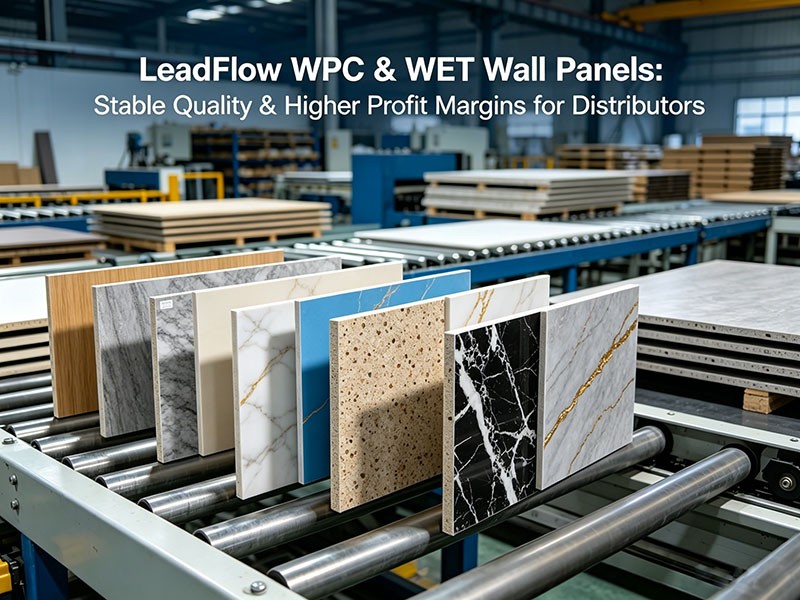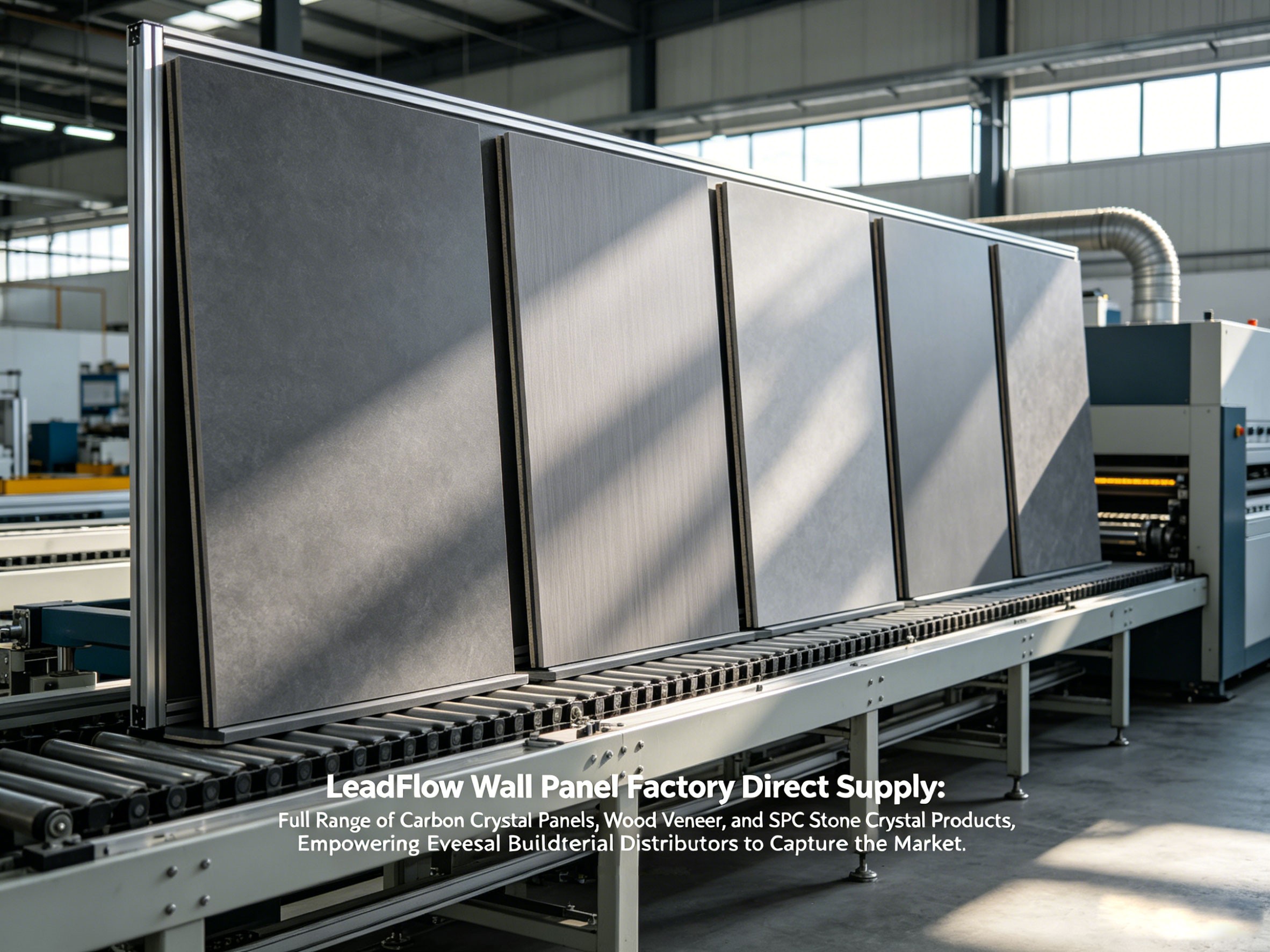
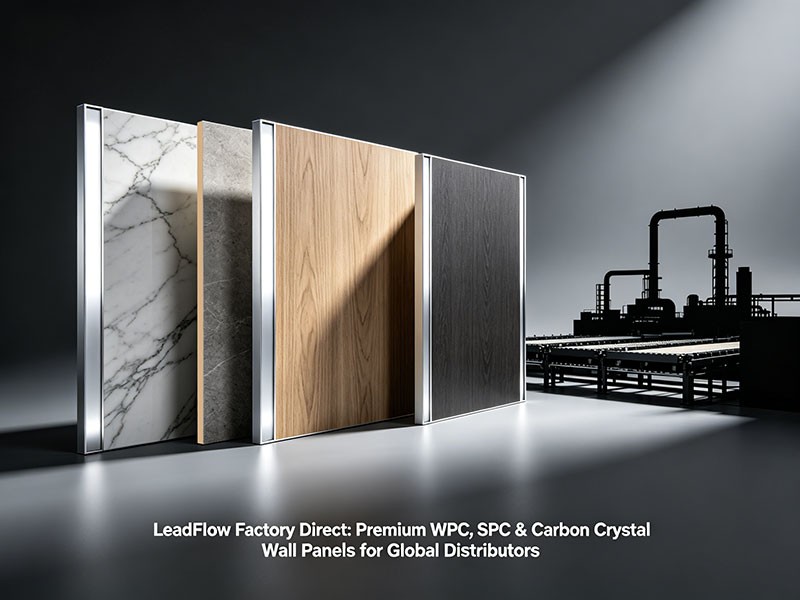
Every premium WPC wall panel displayed in a showroom is the end point of a tightly choreographed industrial journey — one that begins with sacks of wood fiber and polymer resin and ends with a film-laminated profile ready for global shipment. As demand for wood plastic composite interior cladding accelerates across residential, hospitality, and commercial projects, buyers are looking past brochures to understand how these panels are actually made. The difference between a warped, color-inconsistent board and a premium product rarely lies in marketing; it lies on the production floor. This article traces the complete automated workflow behind WPC wall panels — from raw material formulation to finished goods — and explains why manufacturing capability has become the true measure of a WPC Wall Panels supplier.
Key Takeaways
• Premium WPC wall panel quality is decided at the formulation stage, where wood fiber, polymer resin, and additives are weighed and blended under computer-controlled batching.
• Automated extrusion lines regulate temperature, pressure, and haul-off speed in real time, producing profiles with consistent density, dimensional accuracy, and surface finish.
• Film lamination, embossing, UV coating, and inline inspection are now standard capabilities in advanced decorative panel factories serving global markets.
• Understanding the full production workflow helps importers and contractors distinguish a genuinely capable manufacturer from a low-cost assembler.
Raw Material Formulation: Where Panel Quality Begins
The production of premium WPC wall panels starts long before heat and pressure are applied — it starts with the recipe. A typical interior-grade formulation combines three families of inputs: dried wood fiber such as wood flour or rice husk powder, a polymer binder — most commonly PVC resin for interior wall cladding — and mineral filler such as calcium carbonate. Around this core, formulators add a package of functional additives: heat stabilizers, lubricants, foaming regulators, UV absorbers, and color pigments. Each component plays a defined role, and each introduces risk if it is measured imprecisely.
Moisture is the first enemy. Wood fiber must be dried to a strictly controlled level before mixing; residual water turns to steam inside the extruder and causes blisters, voids, and weak interfaces within the panel body. This is why serious manufacturers invest in dedicated drying systems rather than relying on ambient conditions.
The second pillar is gravimetric batching. In a modern plant, every ingredient is metered by weight through automated dosing units that operate under software supervision, with sensors verifying that each batch matches the master formula before it is released. The blend then passes through a hot-and-cold mixer combination: a high-speed hot mixer disperses additives evenly into the polymer, while a cold mixer cools the compound to prevent clumping and pre-gelatinization. This level of dosing precision cannot be achieved with manual weighing, and it is the reason panels from a well-run line look and perform identically — batch after batch, shift after shift.
How Automated Extrusion Lines Shape WPC Wall Panels
Extrusion is the heart of the automated production process, converting the blended compound into a finished profile within minutes. The compound is fed into a conical twin-screw extruder, where the barrel is divided into independently controlled heating zones. Inside, rotating screws shear, knead, and plastify the material while a vacuum vent extracts residual moisture and volatiles. Temperature profiles are tuned to the specific formulation; even a small deviation can change melt viscosity and, with it, the surface gloss and density of the finished panel.
The molten compound is then forced through a precision die that defines the cross-section of the panel — whether a flat board, a fluted profile, or a grooved tongue-and-edge design. Immediately downstream, a vacuum calibration table and water-cooling sleeves lock in the dimensions while the material is still soft. Closed-loop sensors monitor thickness and width continuously, automatically adjusting line speed to hold tolerances tight without operator intervention.
Surface texture can be applied in the same pass. An online embossing roller presses wood-grain or linear textures into the profile, synchronized with line speed so the pattern remains uniform along the entire length. Some lines use co-extrusion to add a harder, more durable outer layer in a single step, eliminating a separate coating operation. Finally, an automated haul-off unit pulls the profile at constant speed, and a flying cutter slices it into preset lengths; panels are stacked by machine to avoid scratches from manual handling.
The same automation logic now extends across the wider decorative panel family. A modern Carbon Crystal Wall Panel factory, for example, applies comparable precision batching and hot-press lamination to produce denser, impact-resistant boards, and many facilities run WPC, carbon crystal, and other panel lines under one roof with shared quality standards. For buyers researching decorative alternatives, resources such as our overview of carbon crystal wall panels explain how these product lines differ in composition and application.
Surface Finishing, Quality Control, and the Road to Finished Goods
What separates a premium panel from a commodity board is decided in the finishing hall and at the inspection line. After extrusion, panels move to lamination stations, where a PVC decorative film or hot-stamping foil is bonded to the surface under controlled temperature and pressure. Servo-driven unwind and tension systems keep the film wrinkle-free and perfectly aligned — a task that demands machine precision, because even slight misalignment is immediately visible on a finished wall. Marble-effect and high-gloss finishes rely on coating chemistry similar to that used by a UV Marble Sheet manufacturer, whose UV-cured lacquer lines deliver surface hardness, stain resistance, and mirror-like gloss; this technology is increasingly adopted on WPC and SPC wall panel lines alike.
Once laminated, panels are cut to length and edge-machined — V-grooves, tongue-and-groove joints, or shiplap edges — by CNC equipment that repeats the same geometry on every piece, which is what allows seamless installation on site. For buyers comparing surface styles, our guide to fluted wall panel design illustrates how embossing and grooving translate current interior design trends into finished products.
Quality control runs in parallel rather than at the end. Inline laser gauges verify thickness; operators audit color consistency under a standardized light source; film adhesion is confirmed through cross-cut tape testing; and samples of each batch are checked for density and impact resistance. Panels that fail any checkpoint are diverted out of the premium stream and recycled into non-visible applications, keeping defects out of containers and waste out of landfills. Every approved batch receives a traceability code, so any question raised after shipment can be traced back to its production window.
Packaging is the final automated step. Panels are protected with corner guards and film, cartoned, strapped, and palletized by machine before loading. For exporters, this stage matters as much as production itself: most transit damage claims traced to ocean freight originate in poor packing, not poor panels.
Conclusion: Automation as the New Benchmark for Panel Manufacturing
The journey from raw material to finished goods explains why two visually identical panels can behave very differently once installed on a wall. Automation — gravimetric dosing, closed-loop extrusion control, synchronized lamination, and inline inspection — has become the defining factor behind consistency at scale, and the gap between automated factories and semi-manual workshops continues to widen. Looking ahead, the industry is moving toward AI-assisted visual inspection, more energy-efficient extrusion systems, and formulations with higher recycled content, pushing wood plastic composite production toward a smarter and more sustainable future.
For buyers, the practical implication is clear: audit the process, not the brochure. When evaluating a WPC Wall Panels supplier, ask about batching tolerances, calibration systems, inspection protocols, and batch traceability. The quality of the answers — like the quality of the panels themselves — is built into the production line, and manufacturers who can demonstrate full-process control are the ones positioned to deliver premium goods at scale, order after order.
FAQ
Q: What raw materials are used to make WPC wall panels?
A: Premium panels are produced from a blend of dried wood fiber, polymer resin (most commonly PVC for interior wall cladding), mineral filler such as calcium carbonate, and functional additives including heat stabilizers, lubricants, foaming regulators, and color pigments. Automated weighing systems keep the ratio consistent from batch to batch.
Q: How does automation improve the quality of WPC wall panels?
A: Automation removes the main sources of human error in panel manufacturing. Gravimetric dosing holds the formulation within tight tolerance, closed-loop extrusion control stabilizes temperature and line speed, and inline sensors continuously monitor thickness and surface condition. The result is lower defect rates, tighter dimensional tolerances, and uniform color across batches.
Q: Where are WPC wall panels best used in interior projects?
A: Because the polymer matrix encapsulates the wood fiber, quality panels resist moisture, rot, and insects, making them well suited to living rooms, bedrooms, hotel lobbies, bathrooms, and feature walls. They install with clips, adhesive, or tongue-and-groove joints and require far less maintenance than paint or wallpaper.
Q: How can buyers verify a manufacturer's production capability before ordering?
A: Request a virtual or on-site factory audit, review batching and quality-control procedures, test samples for thickness tolerance, density, and film adhesion, and ask about batch traceability. A transparent manufacturer will document these processes readily; hesitation to do so is itself a signal worth noting.
Looking for competitive pricing? Request a quote now and let us help you source the right materials.