The global market for decorative interior cladding is shifting from commodity supply to brand-led differentiation. As wood-plastic composite products gain ground in Europe, North America, the Middle East, and Southeast Asia, distributors and home-improvement chains are finding that generic catalog items no longer secure shelf space or healthy margins. OEM/ODM customization has emerged as the decisive strategy for creating exclusive wall panel designs that carry a brand's identity — and for turning a transactional WPC Wall Panels supplier relationship into a long-term product partnership. This article examines how the customization process works, what overseas buyers should prepare, and which safeguards protect both design exclusivity and product quality.
Key Takeaways
• OEM means the brand owns the design and the factory manufactures strictly to specification, while ODM means the factory contributes an existing or adapted design that the brand sells under its own label.
• A professional customization workflow typically moves through design briefing, material and surface selection, prototyping, tooling adjustments, pilot production, and mass production with pre-shipment inspection.
• Compliance documents such as CE marking, fire-performance classifications, and formaldehyde emission grades are essential gatekeepers for entry into regulated overseas markets.
• Intellectual property protection — including non-disclosure agreements and explicit mold-ownership clauses — should be settled in writing before tooling begins.
OEM and ODM Explained: Two Paths to a Private-Label Wall Panel Range
OEM (Original Equipment Manufacturing) and ODM (Original Design Manufacturing) are often used interchangeably in trade conversations, yet they describe fundamentally different levels of involvement. In an OEM arrangement, the overseas brand supplies completed artwork, profile dimensions, color standards, and packaging requirements, and the factory produces exactly to that specification; the brand owns the design and usually the tooling. In an ODM arrangement, the manufacturer proposes base designs drawn from its own mold library and surface-texture portfolio, which the brand can select, modify, and relabel. ODM dramatically shortens time to market, while OEM delivers maximum market exclusivity.
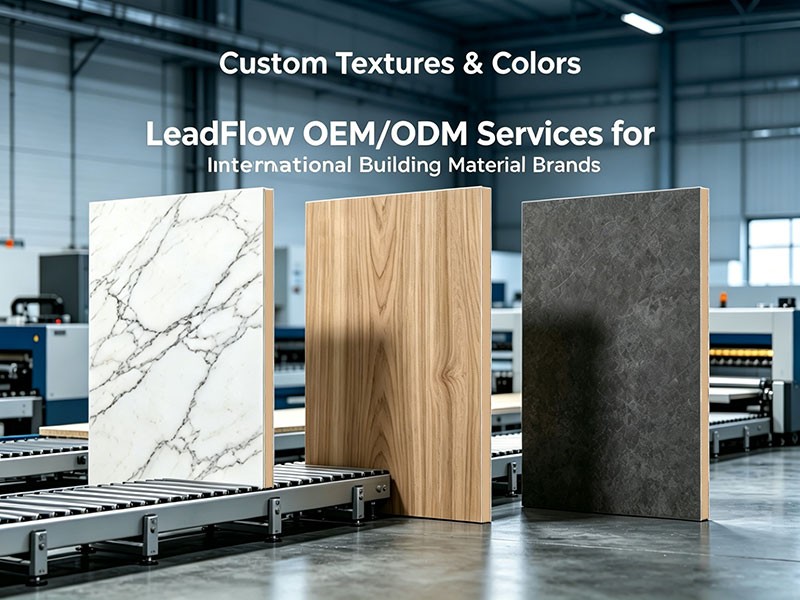
Choosing between the two depends on brand maturity and market positioning. New entrants testing a region often start with ODM, customizing color, surface finish, and packaging on proven profiles to limit commercial risk. Established brands with a defined design language usually move toward full OEM, commissioning unique fluted geometries, embossed wood-grain textures, or stone-look surfaces that competitors cannot replicate. A capable WPC Wall Panels supplier will typically support both models and explain where the cost and lead-time trade-offs sit — for instance, a completely new profile requires mold investment, whereas a customized surface treatment on an existing profile generally does not.
Customization also extends beyond the product itself into elements that shape brand perception: private-label packaging, barcodes and compliance labels matched to destination-market regulations, mixed-container loading plans that balance fast-moving and niche SKUs, and showroom sample sets. Experienced export manufacturers treat these services as part of the customization package rather than as afterthoughts.
Inside the OEM/ODM Customization Workflow: From Design Brief to Container Load
The customization journey follows a broadly standardized sequence, and understanding it helps overseas buyers plan budgets and launch calendars realistically.
Step 1 — Design brief and feasibility. The process starts with the brand defining its target market, price positioning, installation system (tongue-and-groove, clip-on batten, or adhesive), and aesthetic direction. The manufacturer's engineering team then reviews the brief for manufacturability: wall-thickness ratios, groove depth, expansion allowances, and the practical limits of extrusion or hot-press tooling.
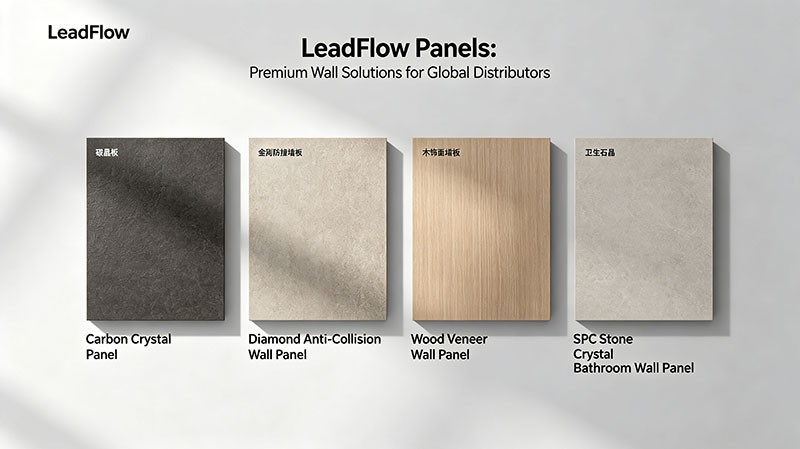
Step 2 — Material and surface selection. This is where product-category choices matter most. Traditional WPC fluted panels offer moisture resistance and dimensional stability at an accessible price point, making them a staple for residential and commercial feature walls. A Carbon Crystal Wall Panel factory, by contrast, works with a denser carbon-crystal board core that accepts deep embossing, high-gloss lacquer effects, and skin-feel matte finishes, positioning it firmly in the premium segment. Meanwhile, a UV Marble Sheet manufacturer specializes in marble-look sheets produced on UV-cured coating lines, delivering the visual depth of natural stone at a fraction of the weight and with far easier fabrication. Many overseas brands now build hybrid collections that combine all three categories under one design language — matte fluted wood tones, tactile carbon crystal feature panels, and book-matched marble-look accents.
Step 3 — Sampling and color matching. Manufacturers produce physical samples against Pantone references, color chips, or the brand's reference images, and two to three iteration rounds are common. Buyers should evaluate samples under both natural and artificial lighting and confirm fire-retardant additives, surface hardness, and edge-profile requirements at this stage, because changing formulations later affects both cost and certification.
Step 4 — Tooling and pilot production. For OEM projects involving new profiles, extrusion dies or hot-press molds are fabricated and tested. Pilot runs expose fine issues — surface line marks, color drift between batches, carton crush points — that are far cheaper to correct now than after mass production begins.
Step 5 — Mass production and inspection. Once the pilot sample is signed off, often via a retained golden sample, production proceeds under in-line quality control. Pre-shipment inspection, whether performed by the brand's team, a third-party inspector, or through live video walkthroughs, closes the loop before containers are sealed and shipped.
Across this workflow, communication cadence is a genuine differentiator. Buyers should clarify upfront who their dedicated contact is, what time-zone coverage applies, and how quickly sample revisions are returned. Factories that document each stage with dated photos and videos reduce misunderstanding considerably, a practice that has become standard among export-oriented manufacturers serving global brands.
Quality, Compliance, and Intellectual Property: Safeguards Overseas Brands Should Demand
Custom design creates commercial value only if it arrives consistently and remains legally protected. Three safeguard areas deserve attention before contracts are signed.
Regulatory compliance. European Union buyers generally require CE marking under the applicable construction-product regulations, together with a fire-performance classification for interior wall cladding. North American projects frequently reference ASTM standards and local building codes. Indoor air quality matters just as much: formaldehyde emission grades and VOC limits are increasingly written into tenders for hospitality, education, and healthcare projects. A professional wall panel manufacturer will supply test reports from recognized third-party laboratories and state clearly which certifications apply to which categories, since carbon crystal boards, WPC profiles, and UV-coated sheets are evaluated under different frameworks.
Production quality systems. Beyond certificates, buyers should assess process discipline: raw-material formulation control covering virgin resin and wood-fiber content and UV stabilizer dosage, in-line thickness monitoring, color management under standardized lighting, and packaging engineering designed for long sea freight. Asking how a factory manages batch-to-batch color consistency is one of the most revealing questions a buyer can pose, because color drift is the most common complaint in decorative panel sourcing.
Intellectual property protection. An exclusive design loses value if it resurfaces in the factory's catalog for other customers. Standard protective instruments include mutual non-disclosure agreements signed before drawings are shared, contractual clauses granting the brand ownership of molds and tooling or buy-back rights, written confirmation that customized designs will not appear at trade fairs or be offered to third parties, and — where commercially significant — design registration in key destination markets. Reputable manufacturers welcome these clauses; reluctance to put them in writing is a clear warning signal.
Conclusion and Outlook
OEM/ODM customization is no longer a premium service reserved for the largest importers; it has become the operating standard through which overseas brands build differentiated wall panel lines. The manufacturers best positioned for this era combine flexible tooling, multi-category portfolios spanning WPC, carbon crystal, and UV marble-look surfaces, documented compliance, and disciplined communication. For brands, the practical playbook is clear: define a precise design brief, choose the OEM or ODM path that matches market maturity, verify compliance early, and secure design ownership in writing. Looking ahead, faster prototyping, digital color-visualization tools, and rising demand for low-emission, recyclable materials will further compress the distance between a brand concept and a retail-ready panel — rewarding partners on both sides who invest in genuine collaborative design.
FAQ
Q: What is the difference between OEM and ODM in wall panel manufacturing?
A: In OEM manufacturing, the brand provides the complete design and the factory produces strictly to that specification, with the brand typically owning the tooling. In ODM manufacturing, the factory supplies base designs from its own library, which the brand selects, modifies, and sells under its private label. OEM offers maximum exclusivity; ODM offers faster time to market and lower upfront investment.
Q: What is a typical minimum order quantity for customized wall panels?
A: MOQs vary with the depth of customization. Color or finish changes on existing profiles generally require a lower MOQ, often starting from a few hundred square meters or a partial container, while fully new OEM profiles involve mold investment and usually require a full container load per item to be economically viable. Buyers should confirm MOQ terms for each SKU and color before sampling.
Q: How long does the customization process take from design brief to delivery?
A: For ODM projects that customize color and packaging on existing profiles, the cycle from approved samples to shipment commonly takes several weeks. Full OEM projects with new tooling typically require additional weeks for mold fabrication, pilot runs, and sample iterations. Sea-freight transit time to the destination market should be added to the production schedule when planning a launch.
Q: How can an overseas brand protect its exclusive panel designs?
A: Sign a non-disclosure agreement before sharing drawings, include written mold-ownership and exclusivity clauses in the supply contract, obtain written confirmation that customized designs will not be displayed at exhibitions or offered to other buyers, and register the design in key destination markets where commercially significant. Working with a manufacturer that has an established export-compliance culture further reduces risk.