
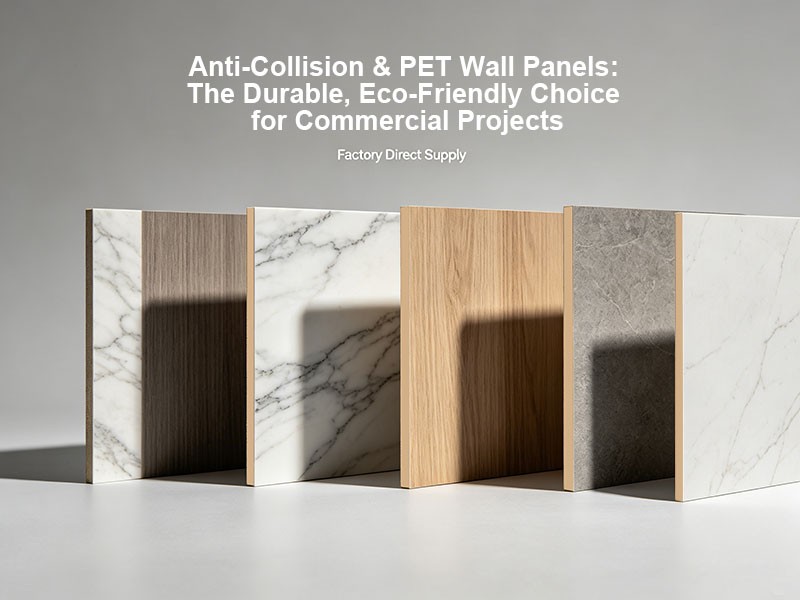
In the global interior finishing market, the surface of a wall panel increasingly decides who wins the project. For any WPC Wall Panels supplier, delivering consistent wood grain, deep embossed textures, and hard-wearing protective coatings has become as critical as the composite formula beneath them. WPC wall panel surface treatment—the family of lamination, hot stamping, embossing, UV curing, and co-extrusion processes applied to the extruded profile—now drives both product differentiation and pricing power. At the same time, customization capabilities such as bespoke color matching, custom embossing rollers, and private-label packaging determine which manufacturers can genuinely serve designers, contractors, and distributors at scale. This article reviews the principal surface treatment technologies used in WPC wall panel production, explains how finish quality is measured, and outlines what international buyers should evaluate when sourcing customized panels.
Key Takeaways
• Surface treatment processes—lamination, hot stamping, embossing, UV coating, and co-extrusion—define the aesthetics, durability, and price positioning of WPC wall panels.
• Finish quality is objectively measurable through cross-cut adhesion tests, abrasion data, gloss readings, and ΔE color tolerance, giving buyers concrete benchmarks before ordering.
• Customization now spans color matching, bespoke embossing cylinders, width and length options, substrate selection, and private-label packaging—not simply film choice.
• Water-based low-VOC coatings, super-matte anti-fingerprint finishes, and digitally printed short runs are the fastest-moving trends in global wall panel sourcing.
WPC Wall Panel Surface Treatment Processes: From Lamination to Co-Extrusion
Surface treatment is the process layer that converts a raw WPC extrusion profile into a finished, decorative, and protected panel. While the wood-plastic composite core determines stiffness, moisture resistance, and dimensional stability, it is the surface engineering that buyers actually see, touch, and judge.
Lamination remains the workhorse of the industry. In this process, a decorative film—typically PVC, PET, or melamine-impregnated paper—is bonded to the profile with PUR hot-melt adhesive under pressure. Lamination offers an enormous design library, from realistic oak and walnut grains to marble and fabric effects, and adds a protective layer that resists scratches and stains. Hot stamping, by contrast, uses heated rollers to transfer pre-printed foil directly onto the surface, integrating the pattern more tightly into the panel and eliminating a separate adhesive layer. The choice between the two affects cost, texture depth, and long-term adhesion performance.
Embossing gives WPC wall panels their tactile signature. In synchronized embossing, the texture roller is registered with the printed grain so that pores and striations align with the wood visual, producing a markedly more premium feel than standard random embossing. Fluted and slatted geometries—popularized by the WPC fluted wall panel trend—combine embossed faces with machined grooves, and the interplay between surface texture and shadow lines is central to their appeal (for a closer look at how fluted geometry shapes interiors, see our guide to WPC fluted wall panel applications).
UV coating has become the default finish for mid- and high-tier interior panels. Multiple lacquer layers are applied and cured instantly under ultraviolet lamps, producing surfaces that range from high gloss to super matte. UV-cured finishes deliver strong scratch, stain, and chemical resistance while keeping volatile organic compound emissions low, an increasingly important criterion in European and North American specifications. Co-extrusion takes a different route: an ASA or PMMA capping layer is fused to the core during extrusion itself, creating a monolithic, film-free surface with exceptional weather and UV stability—well suited to bathrooms, balconies, and semi-exterior cladding where delamination risk must be eliminated.
Finally, water-based painting lines are gaining ground as specifiers push for low-emission finishes and a softer, more natural hand feel. Though slower and costlier than film lamination, painted surfaces can be repaired locally and appeal strongly to premium residential projects.
Measuring Finish Quality: The Benchmarks Buyers Should Demand
Objective test data—not marketing language—is what separates a reliable surface from a failing one. Professional buyers increasingly specify measurable criteria rather than accepting visual samples alone.
Adhesion is assessed with the cross-cut test, in which a lattice of cuts is made through the coating and tape is applied and removed; a low class rating indicates the film will not flake at cut edges during fabrication and installation. Abrasion resistance is commonly evaluated with Taber wheel testing, while pencil hardness indicates scratch performance. For color, factories committed to consistency cap the ΔE color difference between production batches and archive the film batch number used for every run, so replacement panels can be matched years later.
Batch consistency matters most at volume. For distributors running an SPC Wall Panel wholesale program, container-to-container variation in gloss or hue is among the most frequent causes of claims, which is why established plants invest in inline color cameras and standardized lamination parameters rather than relying on operator judgment. Fire performance must also be considered: the coating should not undermine the flame-retardant additives in the core, and reputable producers retest finished laminated panels rather than certifying the substrate alone. Stain resistance against coffee, markers, and common household chemicals completes the picture for residential and hospitality use.
Customization Capabilities: The New Competitive Frontier
Customization has evolved from picking a film from a catalog to co-developing a product. The manufacturers winning premium projects are those able to translate a designer's intent into a repeatable industrial process.
Design flexibility starts with color and pattern. Beyond extensive stock film libraries, capable factories match custom colors from physical samples or Pantone references, while digital printing lines now allow short-run, design-led graphics without the tooling cost of embossing cylinders. Custom embossing remains the deepest level of differentiation: a bespoke texture cylinder carries tooling investment and longer lead times, but it delivers an exclusive tactile identity that competitors cannot copy from a standard film.
Dimensional and structural customization is equally commercial. Widths range from slim fluted slats to wide-format boards, lengths can be cut to project requirements, and edge profiles vary between tongue-and-groove, square edge, and V-groove. Substrate pairing adds another layer: the same surface treatment expertise extends across WPC cores, rigid SPC boards, and PET-faced carbon crystal panels. When evaluating a Carbon Crystal Wall Panel factory, buyers should ask whether PET/PETG lamination, edge banding, and color-matched trims are produced in-house, because outsourced lamination is a common root cause of inconsistent finishes across an order.
Service customization completes the offer. Established suppliers provide OEM and ODM programs covering private-label branding, custom carton design, barcoding, mixed-container loading, and rapid sample development—capabilities that determine whether a factory behaves as a true manufacturing partner or merely a commodity producer. Buyers comparing partners will find our comparison of WPC and SPC wall panel substrates useful for matching surface options to base materials.
Conclusion and Outlook
Surface treatment has moved from a downstream finishing step to the strategic core of WPC wall panel manufacturing. The processes are mature and measurable, but their execution separates commodity output from premium product: adhesion, color discipline, and texture fidelity are earned through equipment and process control, not claims. Looking ahead, three developments will shape sourcing decisions. Water-based and low-VOC coating systems will keep expanding under tightening environmental regulation in Europe and North America. Super-matte, anti-fingerprint, and repair-friendly finishes will continue to take share from high gloss. And digital printing, together with automated visual inspection, will make small-batch customization economically viable for an ever-wider circle of manufacturers. For buyers, the practical conclusion is clear: evaluate a partner's surface treatment capability with the same rigor applied to price, because in this category the surface is the product.
FAQ
Q: What is the most durable surface treatment for WPC wall panels?
A: Co-extruded ASA or PMMA surfaces generally offer the best long-term weather and UV resistance because the protective layer is fused to the core during extrusion, while UV-cured coatings deliver excellent scratch and stain resistance for interior applications. Real-world durability also depends on film thickness, adhesion quality, and the installation environment.
Q: Can WPC wall panels be produced in custom colors and textures?
A: Yes. Most established manufacturers offer custom color matching through film selection or bespoke embossing rollers, though custom textures usually involve tooling costs and minimum order quantities. Digital printing is increasingly used for short-run, design-led customization without cylinder investment.
Q: What is the difference between hot stamping and lamination on wall panels?
A: Hot stamping uses heated rollers to transfer a pre-printed foil directly onto the panel, integrating the pattern into the surface, whereas lamination bonds a separate decorative film—typically with PUR hot-melt adhesive—creating a distinct layer that can add texture and protective performance.
Q: How can I verify surface quality before placing a bulk order?
A: Request production-line samples rather than showroom pieces, and ask for cross-cut adhesion results, abrasion data, gloss readings, and a defined ΔE color tolerance. Third-party inspection before shipment and, where feasible, a factory audit remain the most reliable safeguards in international sourcing.








