
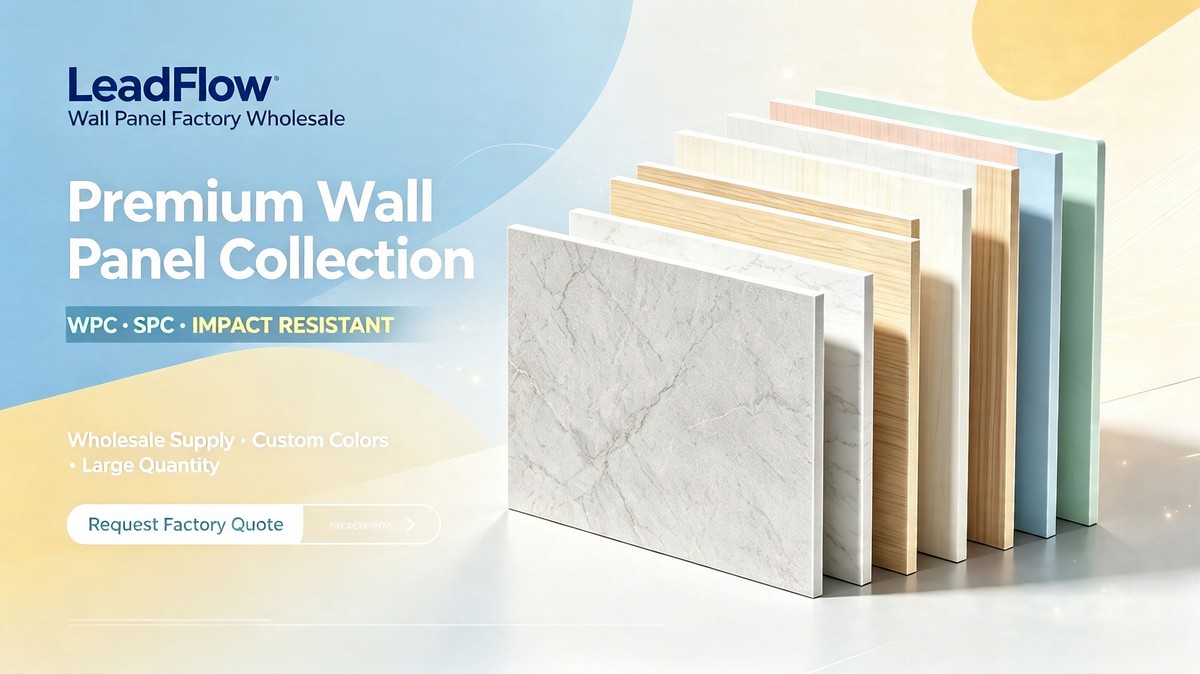
In an increasingly crowded decorative building materials market, product sameness is the biggest threat to an importer's margin. Distributors, retail chains, and design studios across North America, Europe, the Middle East, and Southeast Asia are no longer satisfied with picking items from a supplier's standard catalog; they want products that carry their own brand identity and cannot be matched by the shop next door. This shift has turned OEM/ODM customization from a back-office service into a core competitive strategy for the wall panel industry. When executed well, it converts a generic commodity panel into an exclusive product line with distinct designs, controlled quality, and stronger pricing power. This article explains how the customization process actually works, what overseas brands should prepare, and how to choose a manufacturing partner capable of delivering genuinely exclusive wall panel designs.
Key Takeaways
• OEM means the buyer supplies the design and the factory manufactures to specification; ODM means the factory develops the design and the buyer brands it. The right route depends on a brand's design resources and speed-to-market needs.
• A complete customization cycle covers the design brief, material selection, color and mold development, sampling, compliance testing, mass production, and private-label packaging.
• Partner selection should weigh category expertise, in-house tooling capability, certifications, and intellectual property safeguards — not unit price alone.
• Written agreements on golden samples, tooling ownership, and design exclusivity are what keep an "exclusive" design genuinely exclusive.
OEM vs. ODM: Two Routes to an Exclusive Wall Panel Line
The first decision every brand faces is whether to pursue OEM or ODM production, and this distinction shapes everything that follows. In OEM (Original Equipment Manufacturer) arrangements, the buyer owns the design — artwork, profile drawings, color standards, packaging — and the factory manufactures strictly to that specification. This route offers maximum differentiation and full design ownership, but it demands design capability from the buyer and a longer development timeline.
In ODM (Original Design Manufacturer) arrangements, the factory develops the product in-house and the buyer selects, brands, and distributes it. This route is dramatically faster and requires minimal design investment, but exclusivity is moderate: unless contractually restricted, similar designs may be offered to other customers. In practice, most established suppliers operate hybrid models — for example, an ODM panel body combined with the client's exclusive surface print or a modified profile.
Product category strongly influences what is achievable. An experienced UV Marble Sheet manufacturer, for instance, typically controls the entire chain from PVC base board production to UV coating and decorative grain printing. Such a factory can open its grain library to ODM clients for adaptation, or reproduce a client's own marble artwork under strict OEM confidentiality — adjusting gloss level, veining scale, and surface finish to match the taste of a specific target market.
The OEM/ODM Customization Workflow: From Concept Brief to Branded Container
A professional wall panel customization project follows a structured workflow, and brands that understand each stage communicate more clearly, forecast costs accurately, and avoid costly rework. The cycle generally includes the following phases:
1. Design brief and market positioning. The buyer defines the target segment, price point, aesthetic direction, and technical requirements. Clear reference images, dimensions, and performance expectations at this stage determine the speed of everything downstream.
2. Material and structure selection. Depending on the application, the project may call for WPC fluted panels, UV-coated marble-look sheets, carbon crystal panels, or SPC-based cladding. Core formulation, density, thickness, and backing structure are specified here, since they drive both performance and cost.
3. Color matching and tooling development. This is where exclusive designs take physical form. For fluted profiles, the factory engineers or modifies extrusion dies to create the desired flute geometry, width, and depth. For printed surfaces, engraving or printing plates are produced from the client's artwork. Custom tooling typically represents the largest upfront investment and is the main reason minimum order quantities rise with customization depth.
4. Sampling and golden sample approval. The factory produces pre-production samples, which are reviewed for color accuracy, surface consistency, dimensional tolerance, and mechanical performance. Once approved, the golden sample becomes the binding quality benchmark for mass production.
5. Testing and compliance. Panels destined for regulated markets must meet fire performance standards such as EN 13501 in Europe or ASTM E84 in North America, along with formaldehyde and VOC limits, density requirements, and impact resistance. Verifying certificates against the actual product — not just the sales brochure — is essential.
6. Mass production and quality control. Production runs against the golden sample, with in-line inspection of dimensions, surface quality, and color consistency from batch to batch.
7. Private-label packaging and logistics. Carton design, brand labels, barcodes, and pallet configurations are finalized, and goods ship with documentation matched to the destination market's import requirements.
Matching the Partner to the Product: Capability, Compliance, and Intellectual Property
Not all panel factories are equally suited to exclusive projects, and for overseas brands, category expertise, in-house capability, and intellectual property discipline matter far more than headline pricing. The first criterion is tooling and formulation strength. A capable WPC Fluted Wall Panels supplier should operate its own die workshop and extrusion lines so that flute geometry, panel width and thickness, surface finish, and matching accessories such as trims and corner beads can be engineered to order. Factories that outsource tooling sacrifice both lead time control and design confidentiality — a hidden risk in any exclusive program.
The second criterion is vertical integration, which determines how much design freedom a supplier can actually deliver. For surface-driven decorative categories, a fully integrated UV Marble Sheet manufacturer that extrudes its own base boards, manages decorative film or direct printing, and applies UV coatings in-house can develop exclusive stone-effect designs from artwork to finished panel. By contrast, a factory that purchases semi-finished boards can only re-cut and re-pack common patterns — precisely what brand differentiation seeks to escape.
The third criterion is process control, especially for newer product categories. Carbon crystal wall panels, a high-rigidity decorative format increasingly specified for premium residential and commercial interiors, demand tight control over raw material blending, pressing parameters, and surface hardness. A technically mature Carbon Crystal Wall Panel factory should be able to document density tolerances, edge finishing quality, and batch-to-batch color consistency — and should welcome third-party inspection rather than resist it.
Beyond capability, compliance and quality assurance define the non-negotiable floor for regulated markets. Buyers should verify fire classification against EN 13501 for Europe or ASTM E84 for North America, confirm formaldehyde and VOC limits, and check REACH compliance where applicable to the European Union. Operational safeguards matter just as much: a signed golden sample retained by both parties, defined color deviation windows, pre-shipment inspection rights, and certificates that match the actual shipped goods rather than a generic brochure.
Finally, exclusivity must be protected contractually. Effective measures include non-disclosure agreements covering artwork and formulations, written confirmation that molds, dies, and printing plates remain the buyer's property or are exclusively reserved for the buyer's orders, a defined non-compete period during which the exact design will not be offered to third parties, and design or trademark registration in the destination market. Brands comparing product families during partner selection may find it useful to review a detailed WPC wall panel product range or a fluted panel installation guide to determine which format best fits their project brief before committing to tooling investment.
Conclusion and Outlook
OEM/ODM customization has become the dividing line between commodity importers and genuine brand builders in the wall panel industry. The brands that succeed treat customization as a long-term partnership: they arrive with clear specifications, respect the economics of tooling and order quantities, verify quality and compliance independently, and protect their designs with well-drafted agreements. Looking ahead, three trends will further reshape the landscape. Digital printing and rapid sampling are shortening development cycles, allowing smaller brands to launch exclusive lines with less capital. Sustainability requirements — recycled core materials, low-VOC formulations, and responsible sourcing — are moving from differentiator to baseline expectation. And as more factories compete on customization capability, the decisive advantage will shift to those combining vertical integration, design support, and disciplined project management. For overseas brands, the message is clear: the earlier customization is designed into the sourcing strategy, the stronger and more defensible the resulting product line will be.
FAQ
Q: What is the difference between OEM and ODM in wall panel manufacturing?
A: In OEM production, the buyer provides the design and the factory manufactures strictly to that specification, giving the brand full design ownership. In ODM production, the factory develops the product in-house and the buyer brands and distributes it, which shortens time to market but offers moderate exclusivity. Many suppliers support hybrid arrangements, such as an ODM base panel combined with a client's exclusive surface design.
Q: What is the typical minimum order quantity for customized wall panels?
A: MOQs vary by product category and customization depth. Standard colors and stock profiles often start at relatively low volumes, while fully custom colors, new molds, or exclusive printed designs require higher quantities because tooling, setup, and plate costs must be recovered. Buyers should confirm the MOQ per SKU and per color before entering the design phase.
Q: How long does the OEM/ODM customization process take from design to delivery?
A: A typical cycle ranges from roughly one to three months depending on complexity. Sampling commonly takes one to three weeks, custom mold or plate development adds additional weeks, and mass production plus ocean freight complete the timeline. Rebranding an existing ODM design is the fastest path; a fully original profile with new tooling takes the longest.
Q: How can overseas brands protect their exclusive wall panel designs?
A: Protection combines legal and operational measures: sign NDAs covering artwork and formulations, confirm in writing that tooling and printing plates remain the buyer's property or are exclusively reserved, include a defined period during which the factory will not sell the exact design to others, and register the design and trademark in the destination market. Choosing a vertically integrated factory with in-house tooling further reduces design exposure.
Ready to elevate your next project? Get free samples today and experience the quality firsthand.








